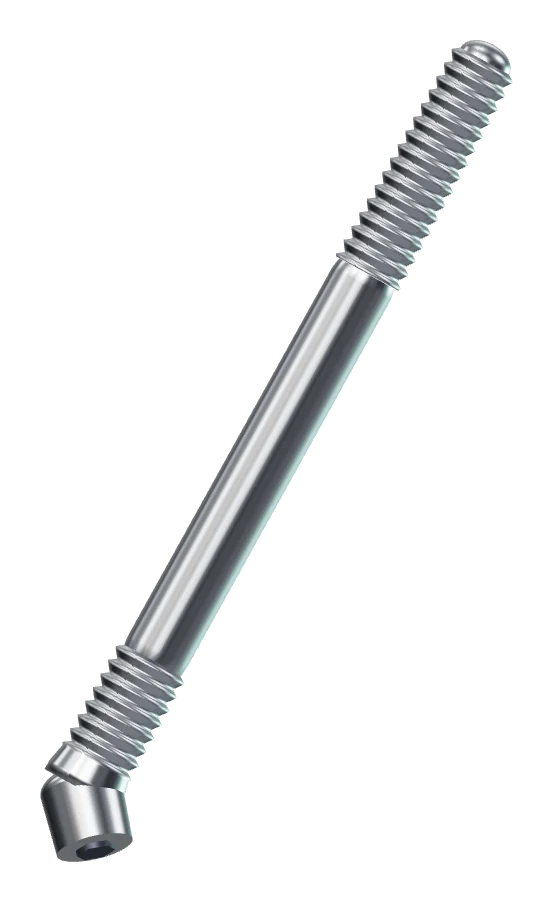
Anchors in: The cheekbone (zygomatic bone)
Zygomatic Implants
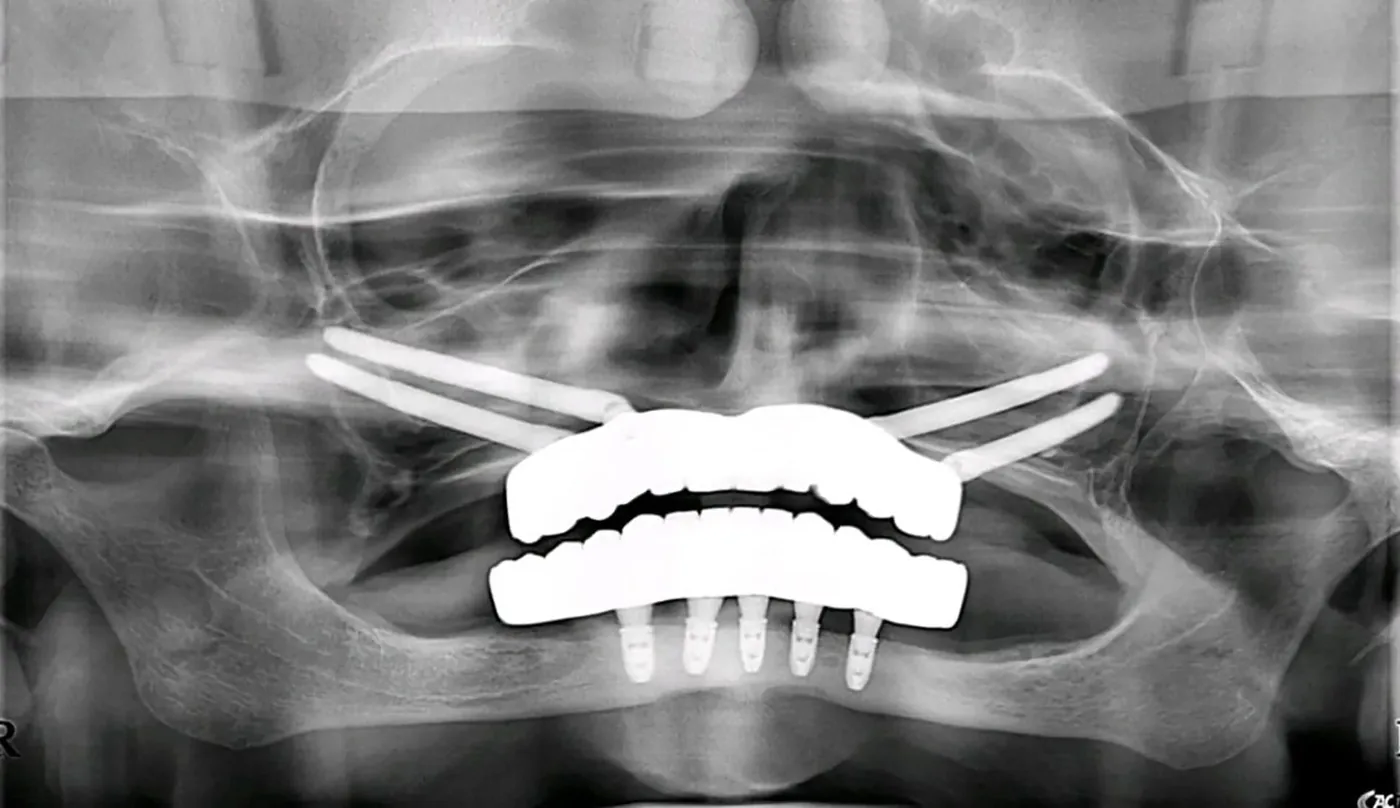
The main purpose of zygomatic implants is to offer a fixed, functional, and aesthetic prosthetic solution to a patient population that, until relatively recently, had very limited options. These patients, due to severe maxillary atrophy, are not viable candidates for the placement of conventional dental implants.
Zygomatic implants represent a specialized solution in advanced oral implantology, designed specifically for the rehabilitation of patients with severe bone loss in the maxilla.
If you lack bone from losing your teeth a long time ago, or if your previous dental implants have failed, zygomatic implants may be the option that gives you fixed teeth again.
This procedure changes not only the outcome but also the process. Instead of waiting months for grafts to integrate without a fixed prosthesis, zygomatic implants allow for the immediate loading of a temporary denture.
Zygomatic Implants
Why the cheekbone
- 01
Uses native, dense bone
The zygomatic bone provides strong cortical anchorage, creating a stable base for long-span prosthetics, even after severe atrophy.
- 02
Graft-less pathway
By bypassing large sinus grafts and iliac crest harvests, treatment time can shorten and morbidity can decrease compared to multi-stage augmentation plans.
- 03
Proven long-term performance
Systematic reviews report high survival, comparable to conventional implants.
Who it is for
- Severe upper-jaw bone loss (Cawood and Howell classes IV to VI), where conventional implants would first need grafts.
- Upper-jaw implants or grafts that failed before.
- You prefer to avoid staged bone grafting and its wait.
- Part of the upper jaw missing after tumor surgery, trauma or a congenital defect (with additional evaluation).
- No usable bone in the front either: four zygomatic implants (quad zygoma) may be indicated.
When it is not the right option
- Active sinusitis or untreated sinus disease: it must be ruled out or treated first.
- Enough bone for a less invasive option (short or tilted implants, bone regeneration): those come first.
- Bone metastases on high-dose antiresorptive drugs (high risk of complications after implant surgery). Past head and neck radiation needs special evaluation.
- Uncontrolled health conditions, or not being fit for anesthesia or sedation.
- Being unable to keep up daily hygiene and long-term check-ups.
How we plan it: your CT and a 3D plan
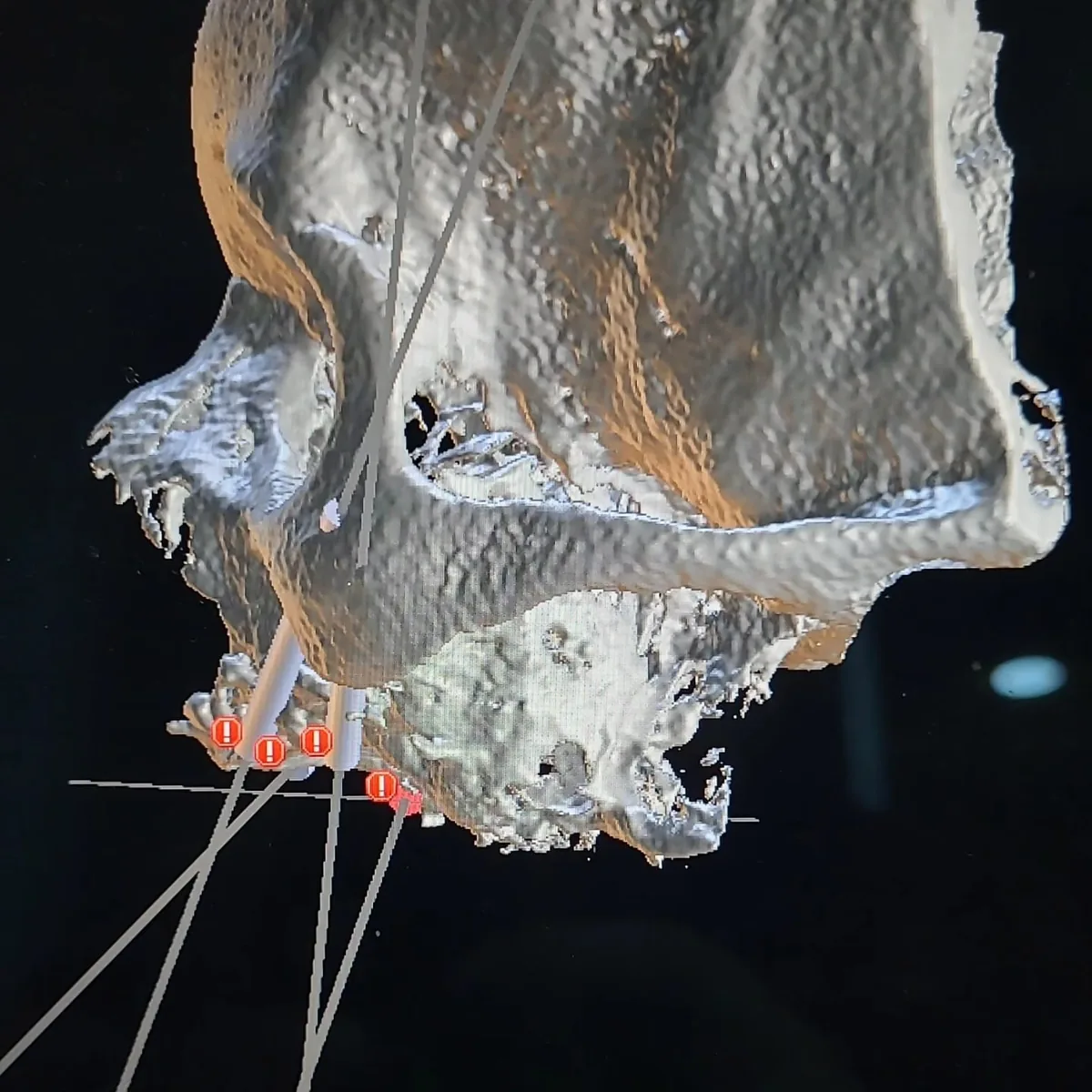
Every case starts with a CT scan that includes the midface. As the 2023 ITI consensus recommends, it lets Dr. Torres measure the bone in your upper jaw and cheekbones and rule out sinus disease before anything is decided.
On that CT, he plans each implant’s path in 3D around the teeth you will receive. Guides and navigation help carry that plan into surgery, but even with them, experts in the ITI consensus consider a direct view of the surgical field essential. We also review your medications and ask you to stop or cut down smoking, which raises implant failure and infection.
Surgery day and your provisional teeth
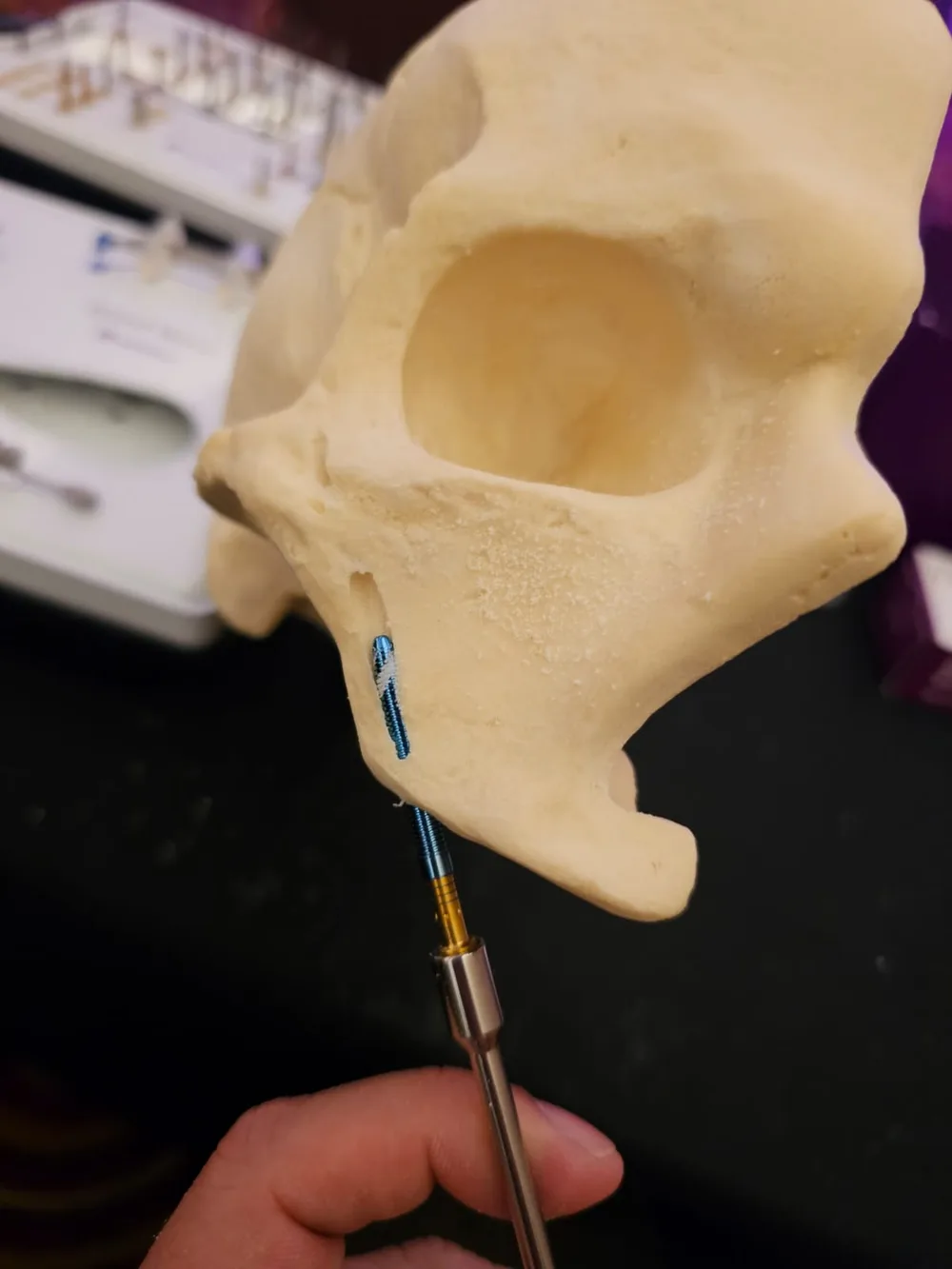
Zygomatic implants are long implants that run from the upper jaw into the cheekbone, alone or with conventional implants in front, and the bridge joins them all. Local anesthesia with sedation, or general anesthesia, is chosen for your case.
If the implants are stable enough, a fixed provisional bridge follows within days. In the main randomized trial, immediate loading required an insertion torque above 40 Ncm, and patients had functional fixed teeth after 1.34 days on average, versus 444.32 days with grafting and conventional implants. If stability is not enough, loading waits.
Zygomatic implants or a bone graft?
The latest Cochrane review, based for this comparison on one randomized trial with three years of follow-up, concludes that zygomatic implants probably have fewer implant failures than conventional implants in grafted bone, but probably more complications; in that trial’s 4-month report, those complications resolved on their own or could be managed.
Complication rates vary widely between studies and may be underestimated; the decision is made case by case, with you.
Why a maxillofacial surgeon leads every surgery
The ITI consensus calls zygomatic implants a complex treatment whose success depends heavily on the surgeon’s skill and experience; a review notes they involve delicate structures such as the orbit. This is facial-skeleton surgery, the field of an oral and maxillofacial surgeon.
Dr. Ronald Torres Labardini leads every surgery at our practice. He completed his oral and maxillofacial surgery specialty at UNAM (Mexico) in 2013, is certified by the Mexican Board of Oral and Maxillofacial Surgery, has been a professor at the University of Costa Rica School of Dentistry since 2006, and is a member of the IAOMS. His office is in Tower 1 of Hospital CIMA, Escazú.
Patients rate his surgical practice 5.0 across 106 reviews on HuliHealth (2019–2026). One wrote in April 2024: “He is highly skilled, shows personal interest in his patients, and works hard to ensure a positive experience and satisfactory result.”
From consultation to final teeth
- First contactTell us about your case, in person or by video call, and send a recent CT or X-ray if you have one.
- Evaluation and CTA clinical exam and a midface CT; sinus findings are checked first, with an ENT if needed.
- Your written planOptions and alternatives, risks, total treatment time and an exact quote, before you decide.
- Surgery dayImplants placed; if they are stable enough, fixed provisional teeth within days.
- HealingSoft diet and close check-ups; most implant losses occur within the first 6 months. In the main trial, 7.17 days of total and 12.17 of partial impaired activity on average.
- Final teethThe final bridge replaces the provisional when healing allows (4 months after loading in the trial’s protocol), then regular maintenance.
Zygomatic Implants
Risks and how we manage them
Every surgery carries risks. These are the real ones for this technique, and what we do about each.
- Sinusitis
- The most reported biological complication; rates vary widely: 2.4% in one large review, 14.2% at 5 years in another, and up to 36.4% in individual studies. It can appear years later. Prevention: ruling out sinus disease on the CT and an implant path suited to your anatomy (paths outside the sinus report less sinusitis). Management: antibiotics and/or sinus drainage surgery; if it does not respond, the implant may be lost.
- Opening between mouth and sinus
- Uncommon: 0.4% to 4.58% depending on the review and technique. Prevention: CT planning and an anatomy-guided technique. Management: surgical closure as needed.
- Numbness of the cheek or upper lip
- Reported in 0.55% to 10.78% depending on the technique; fifteen publications describe it as transient. Prevention: careful, CT-planned technique near the infraorbital nerve. Management: we follow your sensation at each check-up.
- Gum infection or recession
- Soft-tissue infection: 2.0% to 7.50% depending on the review and technique; one study found recession exposing threads in 14% of implants over a mean of 72 months. Experts note that treating recession is not predictable, so prevention comes first: firm gum over the implant, soft-tissue grafts when the risk is foreseen, hygiene and maintenance.
- Eye-area injury and other serious events
- Orbital penetration is known from published cases, not a reliable rate; in a review of eye-related complications, of 41 cases with reported outcomes, 10 needed another procedure and five had irreversible damage. Prevention: CT and 3D planning, an experienced surgeon and a direct view of the field. If your vision changes or your eye area hurts or swells after surgery, contact us immediately or go to an emergency service.
- Implant loss or prosthesis repairs
- The annual risk of losing a zygomatic implant was estimated at 0.7%, higher in the first year (2%) than later (0.5% per year). Prevention: enough initial stability before loading and every implant joined by the bridge. Management: removal and a rescue plan. The most common mechanical issues (loose or broken screws, chipped teeth) are repaired or replaced.
The outcome is about more than just aesthetics. It’s about reclaiming your freedom:
- To Live Without LimitsEnjoy your food again without hesitation, with stable dentures that will not move.
- To Speak with CertaintyThe natural look of your smile allows you to express yourself with total confidence.
- To Leave the Past BehindThe daily discomfort and insecurity of removable dentures are now a thing of the past.
FAQ
Need more info?
Contact us to get answers or schedule your dental implant consultation.
How long do zygomatic implants last?
No one can promise a lifespan, but implant survival is well documented and comparable to conventional implants: 96.5% versus 95.8% of implants in studies with at least 5 years of follow-up, and 95.21% cumulative implant survival at 12 years in a large review. They may need more professional maintenance, so hygiene and check-ups matter.
Do I need two zygomatic implants or four?
It depends on the bone in front: with enough, one zygomatic implant per side plus conventional implants in front; otherwise, four zygomatic implants may be indicated. A review found 97.4% implant survival with four and 98.6% with two plus two conventional implants, with no statistically significant difference.
Can zygomatic implants be used in the lower jaw?
No. They anchor in the cheekbone, so they only serve the upper jaw. For a lower jaw without enough bone, the CT guides other options: short, guided conventional or custom subperiosteal implants.
How long should I stay in Costa Rica, and when can I fly?
We confirm your stay after evaluating your CT. No studies address flying after zygomatic implants; after sinus-lift surgery, experts suggest six weeks, or at least two if the flight cannot wait, and only without sinus symptoms, pain, swelling or bleeding. Dr. Torres makes the final call. Avoid diving while you heal.
How much do zygomatic implants cost?
It depends on your plan: the number of zygomatic and conventional implants, one or both jaws, the provisional and final prosthesis, and any extractions. You get an exact quote after Dr. Torres evaluates your CT.
I was told I don’t have enough bone for implants. Can I still get fixed teeth?
Very often, yes — that is exactly the kind of case we focus on. Instead of grafting, techniques such as zygomatic and pterygoid implants anchor directly into your own basal bone (in areas like the cheekbones or the posterior upper jaw). We confirm which option fits you after a clinical evaluation and a CT scan.
Will I leave with teeth?
Yes. You’ll receive a set of fixed temporary teeth on the very same day of your procedure, or the next, and walk out with a full, natural-looking smile. The definitive restoration comes after the implants integrate with the bone.
Will I be awake? Does it hurt?
Most surgeries are outpatient, under local anesthesia with IV sedation, so you are relaxed and feel no pain during the surgery. A physician anesthesiologist monitors your vital signs throughout. Complex cases are done in the hospital under general anesthesia, and we coordinate your transportation.
Who performs the surgery?
Every surgical procedure is led by our founder, Dr. Ronald Torres Labardini, a board-certified Oral and Maxillofacial Surgeon and professor at the University of Costa Rica.
Sources
- 1.Al-Nawas B et al. — ITI consensus report on zygomatic implants: indications, evaluation of surgical techniques and long-term treatment outcomes. Int J Implant Dent, 2023.
- 2.Visconti RF et al. — Interventions for replacing missing teeth: zygomatic implants for the rehabilitation of the severely atrophic edentulous maxilla. Cochrane Database Syst Rev, 2026.
- 3.Davó R et al. — Immediately loaded zygomatic implants vs conventional dental implants in augmented atrophic maxillae: 1-year post-loading results from a multicentre randomised controlled trial. Eur J Oral Implantol, 2018.
- 4.Esposito M et al. — Immediately loaded zygomatic implants vs conventional dental implants in augmented atrophic maxillae: 4 months post-loading results from a multicentre randomised controlled trial. Eur J Oral Implantol, 2018.
- 5.Brennand Roper M et al. — Long-term treatment outcomes with zygomatic implants: a systematic review and meta-analysis. Int J Implant Dent, 2023.
- 6.Chrcanovic BR et al. — Survival and complications of zygomatic implants: an updated systematic review. J Oral Maxillofac Surg, 2016.
- 7.Moraschini V et al. — Survival and complications of zygomatic implants compared to conventional implants reported in longitudinal studies with a follow-up period of at least 5 years: a systematic review and meta-analysis. Clin Implant Dent Relat Res, 2023.
- 8.Kämmerer PW et al. — Evaluation of surgical techniques in survival rate and complications of zygomatic implants for the rehabilitation of the atrophic edentulous maxilla: a systematic review. Int J Implant Dent, 2023.
- 9.Tavelli C et al. — Survival and complication rate of zygomatic implants: a systematic review. J Oral Implantol, 2022.
- 10.Aboul-Hosn Centenero S et al. — Zygoma quad compared with 2 zygomatic implants: a systematic review and meta-analysis. Implant Dent, 2018.
- 11.Aparicio C et al. — Zygoma Anatomy-Guided Approach “Scarf Graft” for prevention of soft tissue dehiscence around zygomatic implants: technical note. Int J Oral Maxillofac Implants, 2020.
- 12.Aparicio C et al. — ZAGA double pedicle palatal flap for soft tissue management in zygomatic surgery. Int J Periodontics Restorative Dent, 2025.
- 13.Weber MI et al. — Ocular complications of zygomatic dental implants: a systematic review. Cureus, 2024.
- 14.Chrcanovic BR et al. — Survival and complications of zygomatic implants: a systematic review. Oral Maxillofac Surg, 2013.
- 15.D’Ambrosio F et al. — Clinical risk and medico-legal implications in zygomatic implant rehabilitation: an umbrella review of systematic reviews. Diagnostics (Basel), 2026.
- 16.Acerra A et al. — Zygomatic implants for rehabilitation of the atrophic maxilla: clinical indications, outcomes, complications, and evidence gaps — a comprehensive review. Medicina (Kaunas), 2026.
- 17.Schimmel M et al. — Effect of advanced age and/or systemic medical conditions on dental implant survival: a systematic review and meta-analysis. Clin Oral Implants Res, 2018.
- 18.Chrcanovic BR et al. — Smoking and dental implants: a systematic review and meta-analysis. J Dent, 2015.
- 19.Felkai PP et al. — Dental tourism and the risk of barotrauma and barodontalgia. Br Dent J, 2023.
Schedule your consultation
Take the first step to your perfect smile today
We are here to answer your questions and guide you through the process.