
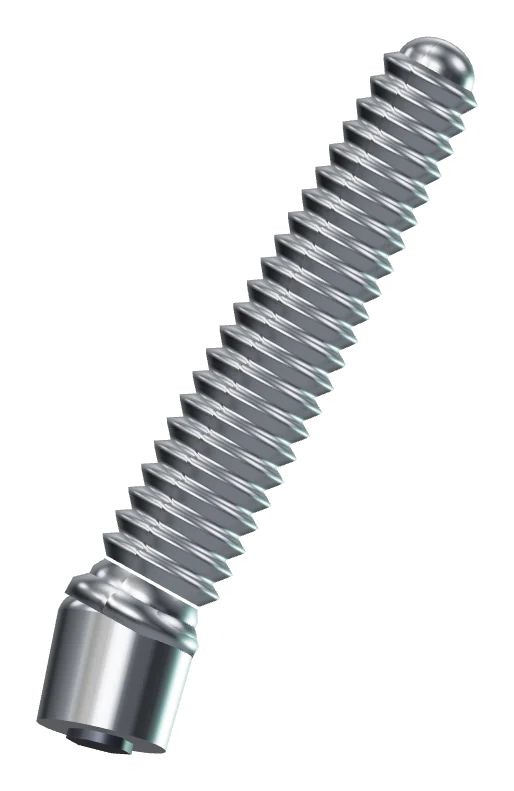
Anchors in: The pterygoid plate, behind the upper jaw
Pterygoid Implants
Pterygoid implants is another of the graftless tools and solutions for the lack of bone anchorage for placing conventional implants. They allow for immediate loading of a temporary denture and, in conjunction with zygomatic implants, they make it possible to solve cases that until recently were considered impossible to resolve with a fixed denture.
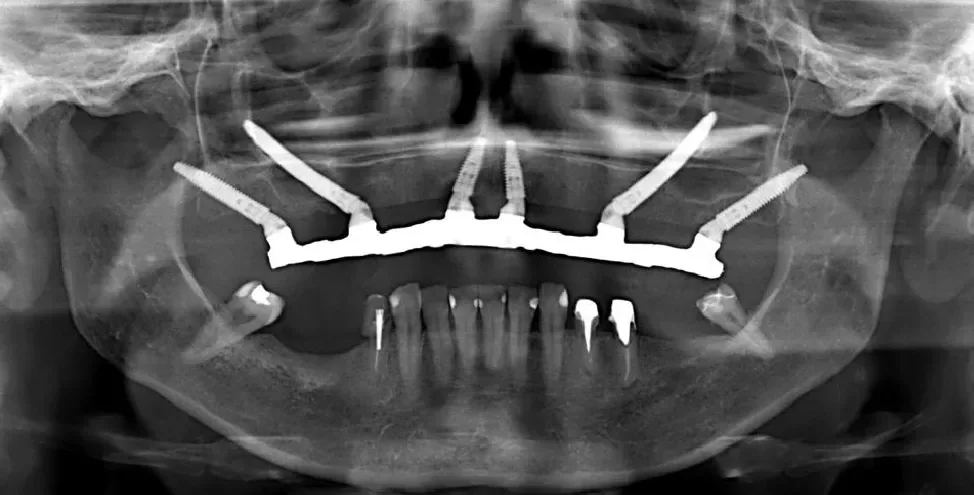
Posterior support without sinus grafts. Pterygoid implants offered at our Costa Rica clinic extend from the maxillary tuberosity into the pterygoid plate of the sphenoid bone, providing strong posterior anchorage in jaws affected by bone loss. This strategy brings back a full arch of fixed teeth with fewer stages and avoids cantilevers that can strain front implants.
Pterygoid Implants
Advantages at a glance
- 01
Stable posterior anchorage in dense cortical bone
Stable posterior anchorage in dense cortical bone, reducing the need for lateral sinus lifts in the back of the maxilla.
- 02
Documented success
Systematic reviews report 95.5% cumulative survival at six years and 97.9% pooled survival across 1,915 implants, supporting reliability when case selection and execution are sound.
- 03
Improved force distribution
By placing implants posteriorly, the final bridge can be shorter and more balanced, which may enhance comfort and maintenance.
Who it is for
- Missing upper back teeth, with too little bone under the sinus for standard implants.
- You want fixed teeth without a sinus lift, its graft and the wait.
- A full-arch bridge that needs support at the back to avoid a long cantilever.
- A plan with zygomatic implants that still needs an anchor at the back of the arch.
- Good mouth opening and a safe path to the pterygoid plate on your CT scan.
When it is not the right option
- Limited mouth opening, or anatomy on the CT with no safe path behind the upper jaw.
- A lone implant not joined to others by a bridge: in one review, unsplinted implants failed more often.
- High-dose antiresorptives for bone metastases, or past radiation to the jaws: these need special evaluation first.
- Enough bone for a simpler option, such as short implants or a sinus lift: we discuss those first.
Where it anchors, and why it can replace a sinus lift
Behind your last upper molar, the jaw ends in the maxillary tuberosity; just behind it, the pterygoid plate of the sphenoid bone offers dense cortical bone. A pterygoid implant runs at an angle from one into the other, holding the back of a bridge where the bone under the sinus has thinned.
The usual way to make room under the sinus is a sinus lift with a bone graft. It is reliable — in studies of five years or more with the lateral-window technique, implant loss was 0.43% per year — but it adds a graft and time. A pterygoid implant uses the bone behind the sinus instead.
What the research says, honestly
The evidence is limited: most studies are retrospective, and a 2026 review rates its certainty as low to very low. Within those limits, a 2026 review of 1,915 pterygoid implants found a pooled survival of 97.9%, and a review of modern rough-surface implants reported 95.5% survival at six years.
There is a trade-off: compared with standard implants in the same studies, survival was 95.25% versus 97.88%, a significantly higher risk of loss (risk ratio 1.54). Another review estimated 10-year survival at 92.5%. That is why we present them as one option among several.
How we plan it, and the day of surgery
Planning starts with a CT scan (CBCT). In 3D we measure the bone at the back of the jaw, check the sinus and the pterygoid region, and plan each implant’s angle and length around your future bridge. The same scan shows whether another option would serve you better.
Pterygoid implants are usually placed in the same surgery as the rest of the arch; anesthesia is defined for your case at the evaluation. When the implants are firm enough, a fixed provisional bridge joins them all — in one review of pterygoid and tuberosity implants, those loaded immediately survived better than those loaded later. You eat soft foods while healing; the final bridge comes once the implants integrate.
Why a maxillofacial surgeon leads every case
The pterygoid region lies deep at the back of the mouth, near blood vessels and jaw muscles. Every surgery at our practice is led by Dr. Ronald Torres Labardini, an oral and maxillofacial surgeon trained at the National Autonomous University of Mexico (UNAM, 2013) and certified by the Mexican Board of Oral and Maxillofacial Surgery (Consejo Mexicano de Cirugía Oral y Maxilofacial).
He has been a professor at the University of Costa Rica School of Dentistry since 2006, is a member of the IAOMS and has been with the AO Foundation since 2012. He sees patients in Tower 1 of Hospital CIMA, Escazú, and holds a 5.0 rating across 104 HuliHealth reviews of his surgical practice.
From consultation to final teeth
- First contactWrite to us and send any CT scan or panoramic X-ray you already have.
- Evaluation, CT and 3D planClinical exam and CBCT. We explain your options, risks and timeline, then plan each implant on your scan.
- Surgery and provisional teethDr. Torres places the implants; the fixed provisional bridge is connected when their stability allows.
- Final teeth and follow-upThe final bridge comes after the implants integrate, on a date set after evaluation, with closer check-ups in the first year.
Pterygoid Implants
Risks and how we manage them
Every surgery carries risks. These are the real ones for this technique, and what we do about each.
- Early loss of an implant
- A 2026 review reported a pooled failure rate of 2.1%; others found failures concentrated in the first year, mostly before the bridge is connected. We place each implant only where it reaches firm bone and join it to the others with the bridge; if one does not integrate, it is removed and the plan adjusted.
- Somewhat lower survival than standard implants
- 95.25% versus 97.88% in comparative studies. We use pterygoid implants where they replace a graft or a cantilever, and design the bridge so it does not depend on a single implant.
- Bleeding
- The region is close to blood vessels. Bleeding is a known risk without a reliable figure in the reviews, which report surgical complications as infrequent. CT planning and careful technique reduce it; if it occurs, it is controlled during surgery.
- Swelling, discomfort and jaw stiffness
- Expected in the first days; managed with medication, cold and a soft diet. If pain or swelling worsens, you have a fever, or bleeding does not stop with pressure, call our office right away or go to the nearest emergency service.
- Smoking and certain treatments
- Across 107 studies, 6.35% of implants failed in smokers versus 3.18% in non-smokers; high-dose antiresorptives for bone metastases and radiation therapy also affect results. Tell us every medication and condition; quitting smoking is part of the plan.
- Gum inflammation over time
- Plaque around any implant bridge can inflame the gums and, eventually, affect the bone. We teach you to clean under the bridge and schedule maintenance visits.
FAQ
Need more info?
Contact us to get answers or schedule your dental implant consultation.
Pterygoid implants or a sinus lift: which is right for me?
It depends on your bone and priorities. A sinus lift is reliable but adds a graft and usually more time before final teeth; a pterygoid implant avoids the graft by anchoring behind the sinus; short implants are a third option for some patients. We compare them on your CT.
How are pterygoid and zygomatic implants different?
Both avoid grafting. A pterygoid implant anchors behind the upper jaw and supports the back of the bridge; a zygomatic implant is longer, anchors in the cheekbone and is used for severe bone loss. They can be combined in one arch.
What are the disadvantages of pterygoid implants?
The surgery is technically demanding: the implant goes in at an angle at the very back of the mouth, needing good mouth opening and careful planning. Pterygoid implants are lost somewhat more often than standard ones, failures cluster in the first year, and the evidence is of low certainty.
Can a pterygoid implant replace a single back tooth?
Rarely. Pterygoid implants are meant to be the back anchors of a bridge joined to other implants: in one review, unsplinted implants failed more often. For a full upper arch, reviews advise no fewer than four implants.
How long do pterygoid implants last?
No one can promise a lifespan. One review reported 95.5% survival at six years; another estimated 92.5% at ten years. Most losses happen in the first year, so early follow-up, not smoking and maintenance matter.
How much do pterygoid implants cost?
It depends on the whole plan: how many implants, whether they are combined with zygomatic or standard implants, any extractions, and the provisional and final bridge. We give you an exact quote after evaluating your CT.
When can I fly home after surgery?
We set the date after checking your healing. Expert recommendations, based on scarce evidence, suggest at least 72 hours after uncomplicated implant placement, generally a week after most dental procedures, and at least two weeks after a sinus lift. Avoid diving and other pressure changes until we clear you.
Do I need a bone graft first?
Our approach is graftless: we anchor specialized implants in dense bone that is still there, so you avoid the cost and the months of waiting that grafts require — and you can receive a fixed provisional prosthesis right away.
Will I leave with teeth?
Yes. You’ll receive a set of fixed temporary teeth on the very same day of your procedure, or the next, and walk out with a full, natural-looking smile. The definitive restoration comes after the implants integrate with the bone.
How is the surgery planned?
We merge your photographs, intraoral scan and 3D CT scan into a virtual model of your anatomy, perform the surgery virtually with millimeter-level accuracy, and fabricate custom surgical guides so each implant goes exactly where it was planned.
Sources
- 1.Gianfreda F et al. — Indications, Techniques and Complications Associated With Pterygoid Implants: A Systematic Review and Meta-Analysis. Clin Implant Dent Relat Res, 2026.
- 2.Diniz DA et al. — Effectiveness of pterygoid dental implants in the complete arch rehabilitation of the edentulous maxilla: a systematic review and meta-analysis. Int J Oral Maxillofac Surg, 2026.
- 3.Raouf K et al. — Clinical Outcomes of Pterygoid and Maxillary Tuberosity Implants: A Systematic Review. J Clin Med, 2024.
- 4.Bidra AS et al. — Implants in the pterygoid region: An updated systematic review of modern roughened surface implants. J Prosthodont, 2023.
- 5.Raghoebar GM et al. — Long-term effectiveness of maxillary sinus floor augmentation: A systematic review and meta-analysis. J Clin Periodontol, 2019.
- 6.Ravidà A et al. — Short (≤6 mm) compared with ≥10-mm dental implants in different clinical scenarios: A systematic review of randomized clinical trials with meta-analysis, trial sequential analysis and quality of evidence grading. J Clin Periodontol, 2024.
- 7.Messias A et al. — Different Interventions for Rehabilitation of the Edentulous Maxilla with Implant-Supported Prostheses: An Overview of Systematic Reviews. Int J Prosthodont, 2021.
- 8.Chrcanovic BR et al. — Smoking and dental implants: A systematic review and meta-analysis. J Dent, 2015.
- 9.Schimmel M et al. — Effect of advanced age and/or systemic medical conditions on dental implant survival: A systematic review and meta-analysis. Clin Oral Implants Res, 2018.
- 10.Felkai PP et al. — Dental tourism and the risk of barotrauma and barodontalgia. Br Dent J, 2023.
Schedule your consultation
Take the first step to your perfect smile today
We are here to answer your questions and guide you through the process.