
Second opinion
Failed dental implants or a failed bone graft: a second opinion on what can be fixed
If an implant bleeds or moves, a full-arch bridge keeps breaking, a bone graft didn't take or your denture won't stay in, you may have been told there is no bone left. That does not always close the options. Dr. Torres reviews your CT and records and explains what is realistic for you. This page helps you prepare; it is not a diagnosis.
Signs an implant may be in trouble
The gum and bone around an implant can become inflamed. Peri-implant mucositis affects the gum alone; peri-implantitis adds loss of the bone that holds the implant. Two recent reviews found peri-implantitis in 21% to 25.0% of patients with implants. It may not hurt at first, so see your dentist if you notice:
- Bleeding when you brush or floss around an implant.
- Red or swollen gum, pus, or a bad taste that keeps coming back.
- Gum pulling back until metal shows.
- A crown, bridge or implant that moves or feels loose.
- Pain when you bite, or a denture that won't stay in.
Swelling that spreads toward your eye or neck, fever, bleeding that won't stop, trouble swallowing or breathing, or a change in your vision can't wait for a review: contact our office or go to an emergency service now.
Can a failing implant be saved?
Sometimes. It depends on whether the implant is still firm and how much bone is gone. A wobbling bridge is often a screw, not an implant, so first we sort out which problem you have:
| What you notice | What it can mean | What usually comes next |
|---|---|---|
| The bridge moves; the implant doesn't | A loose or broken screw, or a cracked bridge | Repair or a new bridge; the implants may be fine |
| Bleeding, swelling or pus; the implant is firm | Mucositis or peri-implantitis | Cleaning and risk-factor control; surgery if bone loss progresses |
| The implant itself moves | It has lost its anchorage in the bone | Removal, healing, then a plan for the bone that remains |
| A loose or sore denture | Shrinking bone, or too few implants holding it | Relining, a new denture, more implants, or fixed teeth if the bone allows |
Mechanical problems are common with full-arch bridges: a review of All-on-4 found mechanical complications in 5.91% and biological ones in 6.54%. In a long series from the clinic that developed the technique, they were far more frequent with the provisional bridge (58.8%) than with the definitive one (7.3%).
Your own dentist or a periodontist can treat much of this. We usually step in when implants must come out and too little bone is left for new conventional ones.
Why implants fail
Most implants last: in studies followed for 10 to 25 years, about 95% were still in place. In place is not the same as healthy, though: success measured with health criteria averaged 85.1%, and each study defined it differently. Early failures never bond to the bone; late ones lose bone after working well. The risk factors with the most evidence:
Smoking
Across 107 studies, 6.35% of implants failed in smokers versus 3.18% in non-smokers; another review found the link with early failure strongest in the upper jaw.
Gum disease
A 2025 AO/AAP review found periodontitis, diabetes, smoking and alcohol to be risk indicators for peri-implantitis: associations, not proven causes.
Poorly controlled diabetes
Well-controlled type 2 diabetes was not a risk indicator. Compared with no diabetes, bone loss around implants was 1.8 mm greater with poor control and 1.2 mm greater with prediabetes; the authors advise checking HbA1c when planning.
Skipped maintenance
Losing an implant appears more likely with irregular or no maintenance visits; the European Federation of Periodontology's 2023 guideline calls for a maintenance program once implants carry teeth.
Too few implants
A review of reviews advises that no toothless upper jaw, fixed or removable, should rest on fewer than four implants; mini-implants there had very high short-term failure (more than 30%).
Radiation and bone medications
Radiotherapy for cancer lowers implant survival, and people with bone metastases on high-dose antiresorptive drugs carry a high risk of complications after implant surgery.
Rescue options when the bone is gone
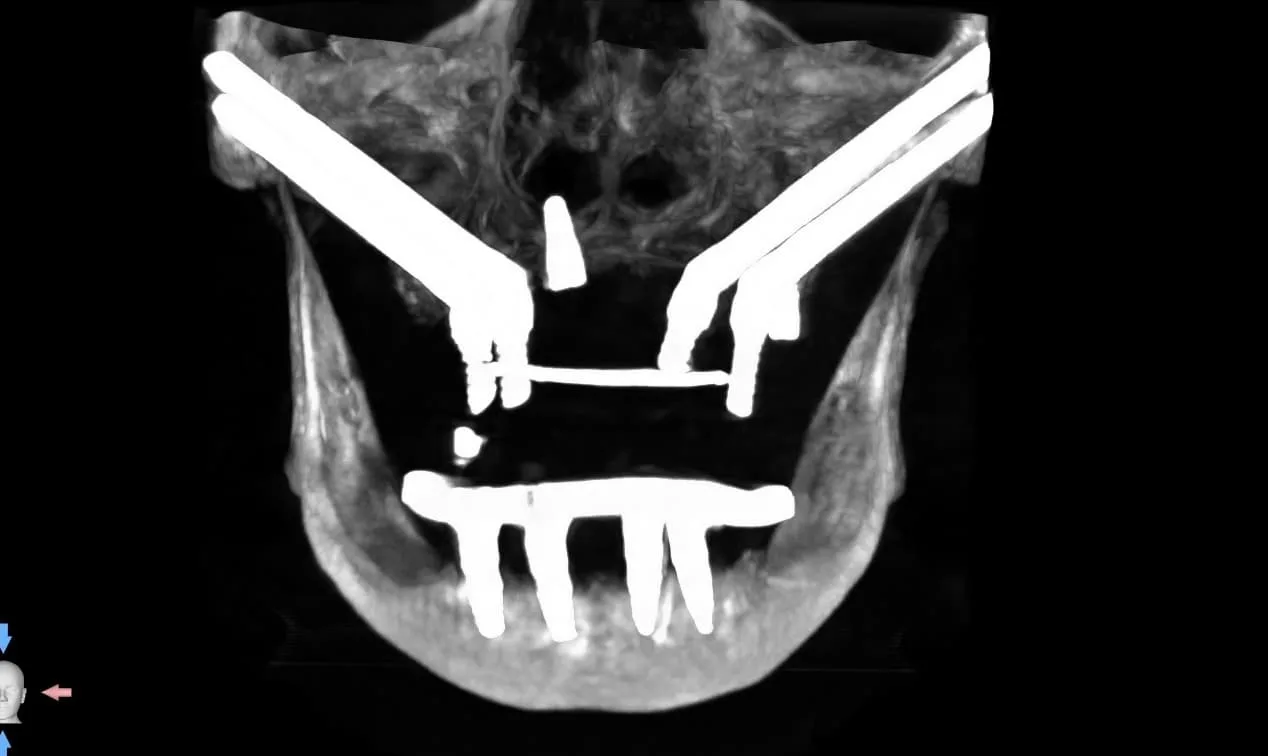
Failed implants and grafts in the upper jaw often take bone with them. The 2023 ITI consensus lists failed grafts or implants among the main indications for zygomatic implants, which anchor in the cheekbone. The options depend on your CT:
| What the CT shows | Options we evaluate |
|---|---|
| Enough bone once the site heals | New conventional, short or tilted implants |
| No bone in the back of the upper jaw | Pterygoid implants, anchored in the bone behind the upper molars, plus front implants |
| Little bone in most of the jaw, front still usable | Two zygomatic implants plus front implants, joined by one fixed bridge |
| No usable bone in front or back | Four zygomatic implants (quad zygoma), always joined by one bridge, when grafting is not feasible, predictable or preferred |
| You would rather avoid surgery | A relined or new removable denture |
These are major procedures with trade-offs. In studies with at least 5 years of follow-up, average survival was 96.5% for zygomatic and 95.8% for conventional implants, with no statistically significant difference. Sinusitis is the most commonly reported biological complication: 2.4% in one large review, 14.2% at 5 years in another. Pterygoid implants showed 97.9% survival in one review (low to very low certainty) and a higher risk of loss than conventional implants in another (95.25% versus 97.88% survival).
With some bone left, a 2026 review advises also weighing less invasive options: short or tilted implants, bone regeneration or a custom subperiosteal implant. The ITI consensus also notes that placing zygomatic implants during tooth extractions can increase risks; when failing implants come out is decided case by case.
What to send for a second opinion
- 01
Your CT scan, as DICOM files
The full set from the imaging center, covering the upper jaw, sinuses and cheekbones; not screenshots or only the report. It is usually too large for a chat message: tell us you have it and we'll explain how to share it.
- 02
Earlier X-rays
Older panoramic X-rays or scans show how the bone has changed.
- 03
Your implant records
Brand and size of each implant, when they were placed, any grafts or sinus lifts, and surgical notes if you have copies.
- 04
Photos and a short timeline
Front, side and bite photos, with and without your denture or bridge, and what has been done so far.
- 05
Your medical history
Conditions, medications (especially bone medications and blood thinners), smoking, radiation and, if you have diabetes, your latest HbA1c.
How the review works
- 01
You send your records
By WhatsApp or email, with a few lines about what is happening.
- 02
Dr. Torres reviews them
He studies the bone, the sinuses and the failing implants on your CT, with your history.
- 03
A video consultation
He explains what he sees, what may be saved and which options may fit, including care close to home.
- 04
An in-person evaluation, if it makes sense
At our office in Tower 1 of Hospital CIMA, Escazú, each option is discussed with its risks, benefits, total time and long-term outcomes; the exact quote comes after the CT evaluation.
A remote review gives a provisional opinion. In-person appointments remain the standard of care, and the exam confirms or changes the plan.
Every surgery at our practice is led by Dr. Ronald Torres Labardini, an oral and maxillofacial surgeon certified by the Mexican Board of Oral and Maxillofacial Surgery. He completed his specialty at UNAM (Mexico) in 2013, has taught at the University of Costa Rica School of Dentistry since 2006, is an IAOMS member and has been with the AO Foundation since 2012.
He holds a 5.0 rating across 104 patient reviews on HuliHealth (2019–2026), about his oral and maxillofacial surgery in general, not implants. On April 6, 2025, a patient wrote: «Claridad en explicar el diagnostico y los eventuales escenarios para proceder con el tratamiento a seguir» (“Clarity in explaining the diagnosis and the possible scenarios for the treatment to follow”).
FAQ
Can a failed implant be replaced?
Often, yes. Once it is removed and the site heals, a new implant can be considered if enough bone remains. If not, the options are a bone graft or, in the upper jaw, implants anchored elsewhere, such as pterygoid or zygomatic implants. The CT decides.
My All-on-4 failed. Do I need zygomatic implants?
Not necessarily. A broken or loose bridge is often a mechanical problem the implants survive. If implants were lost and the upper jaw has no bone for new ones, the ITI consensus lists zygomatic implants as an option after failed implants. They are for the upper jaw only.
My bone graft didn't take. What now?
Another graft may be possible, and a failed graft is also an ITI indication for zygomatic implants. The latest Cochrane review, based here on a single randomized trial, concludes that zygomatic implants probably have fewer implant failures than implants in grafted bone, but probably more complications. We compare both with you.
My implants were placed elsewhere, even abroad. Can you review them?
Yes; that is what a second opinion is for. Records from the first treatment help, but if you can't get them, a new CT still shows the situation today.
How long until I have fixed teeth again?
It depends on whether failed implants or an infection must be treated first. In a randomized trial of immediately loaded zygomatic implants in people with severe bone loss, patients had fixed teeth in an average of 1.34 days; the definitive bridge replaced the provisional 4 months after loading. That was the trial's protocol, not a promise.
How much does a rescue treatment cost?
There is no single price: it depends on what has to be removed, how many implants of which type are needed, and the bridge. You receive an exact quote once Dr. Torres has evaluated your CT.
Sources
- 1.Al-Nawas B et al. — ITI consensus report on zygomatic implants: indications, evaluation of surgical techniques and long-term treatment outcomes. Int J Implant Dent, 2023.
- 2.Reis INRD et al. — The prevalence of peri-implant mucositis and peri-implantitis based on the world workshop criteria: a systematic review and meta-analysis. J Dent, 2025.
- 3.Galarraga-Vinueza ME et al. — Prevalence, incidence, systemic, behavioral, and patient-related risk factors and indicators for peri-implant diseases: an AO/AAP systematic review and meta-analysis. J Periodontol, 2025.
- 4.Shao WH et al. — All-on-4 and All-on-6 implant-supported fixed prostheses for the edentulous jaw: a systematic review and meta-analysis. Int J Oral Maxillofac Surg, 2026.
- 5.Maló P et al. — The All-on-4 concept for full-arch rehabilitation of the edentulous maxillae: a longitudinal study with 5-13 years of follow-up. Clin Implant Dent Relat Res, 2019.
- 6.Moraschini V et al. — Ten years and beyond: long-term dental implant survival, success, and biological health. A systematic review and meta-analysis. Periodontol 2000, 2026.
- 7.Chrcanovic BR et al. — Smoking and dental implants: a systematic review and meta-analysis. J Dent, 2015.
- 8.Fan YY et al. — Smoking in relation to early dental implant failure: a systematic review and meta-analysis. J Dent, 2024.
- 9.Bencze B et al. — Prediabetes and poorly controlled type-2 diabetes as risk indicators for peri-implant diseases: a systematic review and meta-analysis. J Dent, 2024.
- 10.Carra MC et al. — Primordial and primary prevention of peri-implant diseases: a systematic review and meta-analysis. J Clin Periodontol, 2023.
- 11.Herrera D et al. — Prevention and treatment of peri-implant diseases: the EFP S3 level clinical practice guideline. J Clin Periodontol, 2023.
- 12.Messias A et al. — Different interventions for rehabilitation of the edentulous maxilla with implant-supported prostheses: an overview of systematic reviews. Int J Prosthodont, 2021.
- 13.Schimmel M et al. — Effect of advanced age and/or systemic medical conditions on dental implant survival: a systematic review and meta-analysis. Clin Oral Implants Res, 2018.
- 14.Moraschini V et al. — Survival and complications of zygomatic implants compared to conventional implants reported in longitudinal studies with a follow-up period of at least 5 years: a systematic review and meta-analysis. Clin Implant Dent Relat Res, 2023.
- 15.Chrcanovic BR et al. — Survival and complications of zygomatic implants: an updated systematic review. J Oral Maxillofac Surg, 2016.
- 16.Brennand Roper M et al. — Long-term treatment outcomes with zygomatic implants: a systematic review and meta-analysis. Int J Implant Dent, 2023.
- 17.Gianfreda F et al. — Indications, techniques and complications associated with pterygoid implants: a systematic review and meta-analysis. Clin Implant Dent Relat Res, 2026.
- 18.Diniz DA et al. — Effectiveness of pterygoid dental implants in the complete arch rehabilitation of the edentulous maxilla: a systematic review and meta-analysis. Int J Oral Maxillofac Surg, 2026.
- 19.Acerra A et al. — Zygomatic implants for rehabilitation of the atrophic maxilla: clinical indications, outcomes, complications, and evidence gaps — a comprehensive review. Medicina (Kaunas), 2026.
- 20.Visconti RF et al. — Interventions for replacing missing teeth: zygomatic implants for the rehabilitation of the severely atrophic edentulous maxilla. Cochrane Database Syst Rev, 2026.
- 21.Davó R et al. — Immediately loaded zygomatic implants vs conventional dental implants in augmented atrophic maxillae: 1-year post-loading results from a multicentre randomised controlled trial. Eur J Oral Implantol, 2018.
- 22.Cronin AJ et al. — Evaluation of remote OMFS assessments in the era of pandemic COVID-19 control measures. Br J Oral Maxillofac Surg, 2020.
Schedule your consultation
Take the first step to your perfect smile today
We are here to answer your questions and guide you through the process.