
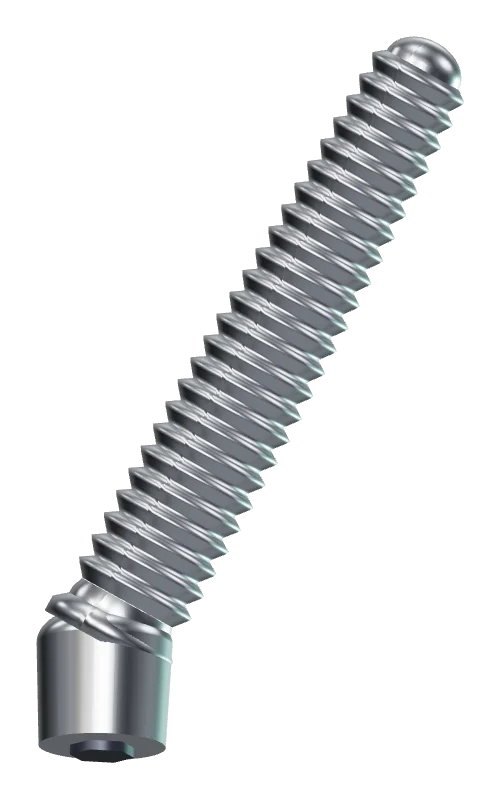
Anchors in: The front of the upper jaw (premaxilla)
Transnasal Implants
The transnasal implant technique is another tool for resolving severe maxillary atrophy. In conjunction with zygomatic and pterygoid implants, it allows avoiding the use of bone grafts, which require not only a financial investment but also time, and which prevent the immediate loading of fixed prostheses.
Through this technique, and in conjunction with conventional implants or any of the other graftless techniques, the immediate placement of a fixed denture can be achieved, allowing the patient to swiftly recover function and aesthetics.
This procedure is considered less invasive than zygoma implants and usually may be performed under intravenous sedation on a regular dental chair basis.
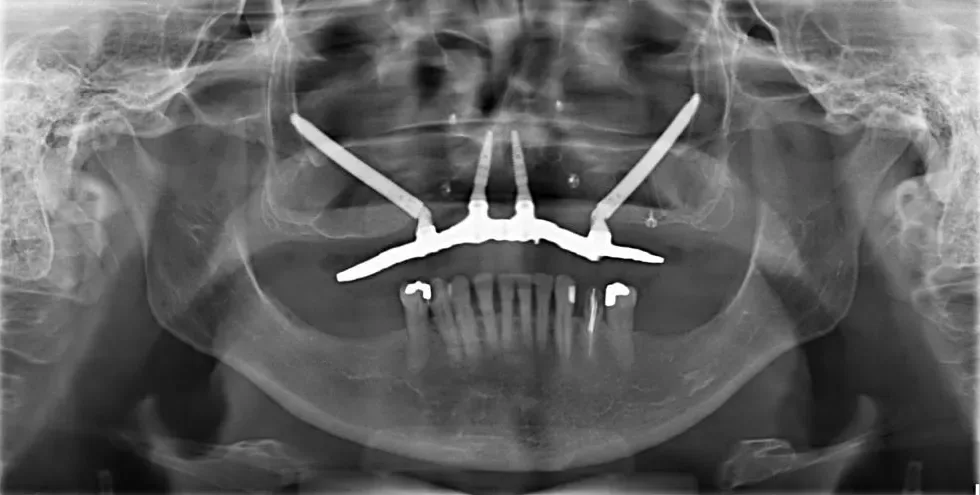
Transnasal Implants
What it means for you
- 01
No graft to wait for
Bone grafts require not only a financial investment but also time, and they prevent the immediate loading of fixed prostheses.
- 02
A fixed denture right away
Combined with conventional implants or the other graftless techniques, the immediate placement of a fixed denture can be achieved.
- 03
Less invasive
Considered less invasive than zygoma implants; usually performed under intravenous sedation in a regular dental chair.
Who it is for
- The bone at the front of your upper jaw (the premaxilla) is too thin or too short for conventional implants.
- You want a fixed upper bridge without bone grafts.
- Without a front anchor, your plan would need a second pair of zygomatic implants (“quad zygoma”) for the front teeth.
- Your CT scan shows healthy nasal and sinus anatomy and a safe path for each implant.
- You can keep up daily cleaning and regular check-ups.
When it is not the right option
- There is enough bone in front for conventional or tilted implants: the simpler option comes first.
- Active nasal or sinus disease, which must be treated first.
- A CT scan with no safe path, for example a tear duct too close to the planned implant.
- High-dose bone medication for cancer, radiation to the jaws or an uncontrolled medical condition: these need a separate medical evaluation first.
Where transnasal implants fit
A transnasal implant is a long implant placed from inside the mouth, in the front of the upper jaw. Instead of relying on the thin bone under the gum, it is angled to reach the firmer bone along the floor and side walls of the nose. Nothing shows on the face.
When conventional implants cannot be placed in the back or the front of the jaw, the ITI consensus describes a second pair of zygomatic implants (quad zygoma). Transnasal implants have been proposed as an alternative front anchor that avoids that second pair.
We say it plainly: this is a less-studied technique, backed only by case series and small studies, with no comparative trials. The largest series followed 226 transnasal implants in 121 patients, all with immediate loading, and reported no early or late failures 1 to 8 years after surgery. Encouraging, but without a comparison group it does not predict any one patient’s result.
How we plan it: CT scan and 3D planning
Planning starts with a CT (CBCT) scan. For the zygomatic implants that may be part of the same plan, the ITI consensus recommends a scan that includes the midface, to measure the bone in three dimensions and check sinus health.
Transnasal implants add one task: their path runs close to the tear duct (the nasolacrimal duct). A single-case study proposed checking that path on the CBCT before surgery, as a method demonstration, not a validated protocol. The principle stands: each path is checked on your scan against the nose, the sinus and the tear duct.
The plan covers the whole arch: a fixed upper bridge should not rest on fewer than four implants. Dr. Torres reviews the options with you: risks, benefits and total treatment time.
The day of surgery and your provisional teeth
This procedure is considered less invasive than zygomatic implants and can usually be done under intravenous sedation in the dental chair. If your plan includes zygomatic implants, anesthesia is decided for the whole surgery.
The goal is a fixed provisional bridge right away, but only if the implants are firm enough (insertion torque, measured during surgery). Studies differ: in the largest series every patient received immediate loading; in a retrospective series of 52 implants, 45% of patients had torque below 50 Ncm and their teeth were connected later. If the implants are not firm enough, waiting is safer.
Expect swelling, bruising and tenderness of the lip and under the nose in the first days; you will get instructions for diet, cleaning and medication.
Why a maxillofacial surgeon leads it
Working beside the nose, the sinus and the tear duct is midface surgery, the field oral and maxillofacial surgeons train in. For zygomatic implants, the ITI consensus notes that success depends heavily on the clinician’s skill and experience.
Every surgery at our practice is led by Dr. Ronald Torres Labardini: oral and maxillofacial surgery specialty at the National Autonomous University of Mexico (UNAM, 2013), certified by the Mexican Board of Oral and Maxillofacial Surgery (Consejo Mexicano de Cirugía Oral y Maxilofacial), professor at the University of Costa Rica School of Dentistry since 2006, IAOMS member, with the AO Foundation since 2012. His office is in Tower 1 of Hospital CIMA, Escazú.
Across his surgical practice, he holds a 5.0 rating in 106 patient reviews on HuliHealth. One patient wrote (April 7, 2024): “He is highly skilled, shows personal interest in his patients, and works hard to ensure a positive experience and satisfactory result.”
From consultation to final teeth
- First contactTell us about your case and send a recent CT scan or panoramic X-ray if you have one.
- Consultation and CT scanA clinical exam and a CT scan including the midface. Dr. Torres explains every option, including not operating.
- Plan and quoteEach implant is planned on your scan. The exact quote comes after the CT is evaluated.
- Surgery dayIf the implants are firm enough, a fixed provisional bridge is connected; if not, it is connected later.
- Healing and final bridgeSoft diet and check-ups while the bone heals; the final bridge follows on a timeline set after evaluation.
Transnasal Implants
Risks and how we manage them
Every surgery carries risks. These are the real ones for this technique, and what we do about each.
- Injury to nearby structures (nose, tear duct)
- The implant path runs close to the nasal cavity and the tear duct. Each path is planned on the CT scan; if a structure is affected, management depends on which one.
- Not firm enough for immediate teeth
- In one series, 45% of patients had insertion torque below 50 Ncm and their teeth were connected later. Torque is measured during surgery; when it is low, the provisional bridge waits.
- Bleeding, swelling and nasal symptoms
- Some bleeding and swelling are expected; active nasal or sinus disease is treated before surgery. If bleeding does not stop, or pain, swelling, fever or discharge increase, contact the office right away or go to emergency services.
- Losing an implant
- The series of 226 and 52 implants cited above report no failures, but they lack a comparison group. Smoking raises the risk: across 107 studies of dental implants, 6.35% of implants failed in smokers versus 3.18% in non-smokers. A failed implant is removed and the plan is redone.
- Problems with the bridge
- Loose or broken screws and chipped acrylic or ceramic are the most common mechanical problems with full-arch bridges on zygomatic implants. Check-ups catch them early; patient education in oral hygiene is paramount.
FAQ
Need more info?
Contact us to get answers or schedule your dental implant consultation.
Does a transnasal implant go into my nose?
It is placed from inside the mouth, and nothing shows on the face. Its tip reaches the bone along the floor and side walls of the nose, near the nasal cavity and the tear duct, which your CT scan maps first. A mild nosebleed or stuffy nose can happen in the first days.
Transnasal implants or quad zygoma: how is the choice made?
It depends on your front bone, your nasal anatomy and the rest of your plan. Transnasal implants can avoid a second pair of zygomatic implants, but their evidence is thinner. Grafting the nasal floor and an implant in the nasopalatine canal are other studied options. Dr. Torres explains which fits you after reviewing your CT scan.
Are transnasal implants used on their own?
No. They are combined with conventional, zygomatic or pterygoid implants, depending on where bone remains, as part of a full-arch plan.
How well do transnasal implants hold up over time?
The evidence is limited to case series. One retrospective series reported all 52 nasal or transnasal implants successful in 31 patients; in another, 18 transnasal implants in 10 patients showed an average bone loss of 0.70 mm one year after loading. Encouraging early results, not a promise: hygiene, check-ups and not smoking matter.
How soon can I fly home after surgery?
No studies cover flying after transnasal implants. Expert guidance suggests at least 72 hours after uncomplicated implant placement, ideally one week, and at least two weeks after a sinus lift. Dr. Torres sets your date based on your whole surgery and how you heal.
Do I need a bone graft first?
Our approach is graftless: we anchor specialized implants in dense bone that is still there, so you avoid the cost and the months of waiting that grafts require — and you can receive a fixed provisional prosthesis right away.
Will I be awake? Does it hurt?
Most surgeries are outpatient, under local anesthesia with IV sedation, so you are relaxed and feel no pain during the surgery. A physician anesthesiologist monitors your vital signs throughout. Complex cases are done in the hospital under general anesthesia, and we coordinate your transportation.
Will I leave with teeth?
Yes. You’ll receive a set of fixed temporary teeth on the very same day of your procedure, or the next, and walk out with a full, natural-looking smile. The definitive restoration comes after the implants integrate with the bone.
Sources
- 1.Camargo VB et al. — Transnasal Implants as an Alternative to Quadzygoma in the Rehabilitation of Extremely Atrophic Maxillae: Long-Term Results of the Vanderlim Technique Cases Report. Int J Oral Maxillofac Implants, 2026.
- 2.Gelpi F et al. — A Retrospective Multicentric Study of 52 Nasal and Transnasal Implants in 31 Severely Atrophic Patients to Reduce Anterior Cantilever Bending in Full-Arch Implant-Supported Fixed Rehabilitations. Int J Oral Maxillofac Implants, 2025.
- 3.Eshoiee N et al. — Trans-nasal dental implants: indication and the report of 10 cases. Ann Med Surg (Lond), 2025.
- 4.David AP et al. — Evaluating Safety and Anatomical Eligibility for Paranasal Implants in the Atrophic Maxilla: A Segmentation-Assisted Proof-of-Concept Study. J Clin Med, 2026.
- 5.Al-Nawas B et al. — ITI consensus report on zygomatic implants: indications, evaluation of surgical techniques and long-term treatment outcomes. Int J Implant Dent, 2023.
- 6.Messias A et al. — Different Interventions for Rehabilitation of the Edentulous Maxilla with Implant-Supported Prostheses: An Overview of Systematic Reviews. Int J Prosthodont, 2021.
- 7.Acerra A et al. — Zygomatic Implants for Rehabilitation of the Atrophic Maxilla: Clinical Indications, Outcomes, Complications, and Evidence Gaps-A Comprehensive Review. Medicina (Kaunas), 2026.
- 8.Krennmair G et al. — Transsinusoidal lateral nasal floor augmentation for implant placement in the atrophic premaxilla: A within-patient, 5-year, prospective comparative study. Clin Oral Implants Res, 2023.
- 9.Leighton Y et al. — Using the Nasopalatine Canal for Enhanced Distribution in Severely Atrophic Maxilla With Immediate Loading of Zygomatic Implants: An 8-Year Retrospective Cohort Study. J Craniofac Surg, 2025.
- 10.Chrcanovic BR et al. — Smoking and dental implants: A systematic review and meta-analysis. J Dent, 2015.
- 11.Schimmel M et al. — Effect of advanced age and/or systemic medical conditions on dental implant survival: A systematic review and meta-analysis. Clin Oral Implants Res, 2018.
- 12.Felkai PP et al. — Dental tourism and the risk of barotrauma and barodontalgia. Br Dent J, 2023.
Schedule your consultation
Take the first step to your perfect smile today
We are here to answer your questions and guide you through the process.