Cost and your quote
How much do zygomatic implants cost in Costa Rica? What sets the price
We don't publish a single price for zygomatic implants, because two people who need them rarely need the same treatment. The number of implants, the teeth you receive, the anesthesia, the setting and the travel all change it. Here is what goes into the cost, what a complete quote should list and how to compare offers. Your exact quote comes after Dr. Torres evaluates your CT.
Why there is no single price
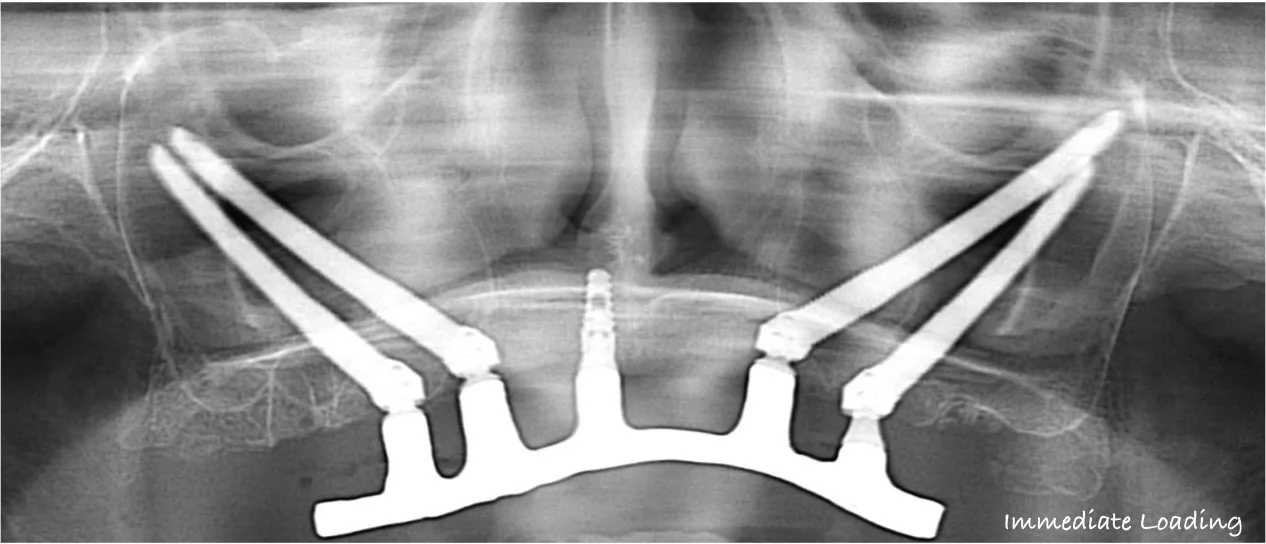
A zygomatic implant is one part of a treatment that rebuilds a whole upper jaw. The ITI consensus on zygomatic implants asks that each case be analyzed individually and that the options be discussed with the patient: risks, benefits, the final result, the total treatment time and long-term outcomes. The cost follows from those decisions.
That is why everything starts with a CT or CBCT scan that includes the midface. It shows how much bone is left in your upper jaw and cheekbones and whether your sinuses are healthy, and that decides how many implants you need and of which kind.
Once Dr. Torres has evaluated your CT, you receive a written plan with your options, the alternatives, the risks, the total treatment time and an exact quote, before you decide anything.
What determines the cost
How many implants, and which kind
Some plans use two zygomatic implants with conventional implants in the front. When the front of the jaw has no usable bone either, four zygomatic implants (quad zygoma) may be indicated, all joined by the bridge; others add pterygoid or transnasal implants. An overview of systematic reviews concluded that no implant rehabilitation of the toothless upper jaw should rely on fewer than four implants.
One jaw or both
Zygomatic implants are only for the upper jaw. If your lower jaw also needs treatment, it is planned on its own, with other techniques, and adds to the treatment.
Extractions
If you still have upper teeth, removing them is part of the plan. Placing zygomatic implants the same day as extractions may increase risks, so infection, bone and gum quality are weighed first. That choice can change the number of surgeries and visits.
The fixed provisional bridge
When the implants are firm enough, a fixed provisional bridge follows within days. In the main randomized trial, immediate loading required an insertion torque above 40 Ncm, and the provisional was acrylic reinforced with metal.
The final bridge and its material
The provisional is later replaced by the final bridge: in that trial, after 4 months, with a titanium framework and ceramic or acrylic teeth. Material matters: in a review of All-on-4 treatment, the main prosthetic complication was fracture of all-acrylic bridges, and a 2026 review of All-on-4 and All-on-6 notes that zirconia bridges may reduce mechanical complications.
CT, planning and anesthesia
The CT, the digital plan (planning software with your future teeth and 3D models are an option) and the anesthesia or sedation, with the setting where surgery is done, are chosen for your case.
What a complete quote should list
Wherever you are treated, ask for the total in writing, item by item. A complete quote for zygomatic implants should tell you:
- The consultation, the CT review and whether a new CT is needed.
- The number of implants of each type: zygomatic, conventional, pterygoid or transnasal.
- Any extractions or other procedures, and whether they happen in the same surgery.
- The anesthesia or sedation, who provides it and where the surgery takes place.
- The fixed provisional bridge, and how adjustments or repairs are handled while you wear it.
- The final bridge: its material, when it is made and how many fittings it takes.
- Medications and follow-up visits through the final bridge and the first year.
- What happens if an implant is lost or the bridge breaks.
- What is not included, such as flights, lodging and meals.
- When each payment is due and in which currency.
A quote that names only a price per implant leaves out most of the treatment: the bridge, the surgery and the follow-up.
Why prices online vary so much
Figures you find online rarely measure the same thing. Some are per implant, some per arch with teeth, some are “from” prices for the simplest case, and some directory listings don't say what the figure covers at all, so a per-implant number can sit next to a full-arch number as if they were comparable.
| What you see | What it may leave out | What to ask |
|---|---|---|
| A price per implant | The bridge, the surgery, anesthesia, the CT and the follow-up | What is the total for my upper jaw, with teeth? |
| A price per arch | Whether it means two or four zygomatic implants, and which bridge | How many implants of each type, and which provisional and final bridge? |
| A “from” price | The case that price actually applies to | What would my case cost once you have seen my CT? |
| A travel package | The later trip for the final teeth, or extra nights if healing takes longer | How many trips and nights does my plan need? |
| A comparison with another country | Materials, follow-up and care after you fly home | Who sees me if something needs attention at home? |
Compare total treatment, not line items: the same number and type of implants, the same provisional and final bridge, the same follow-up. The Australian Dental Association adds that good oral health is not achieved in a single episode of treatment and needs regular maintenance, so the plan for care after you go home belongs in the comparison.
Zygomatic implants or staged grafting: time and procedures
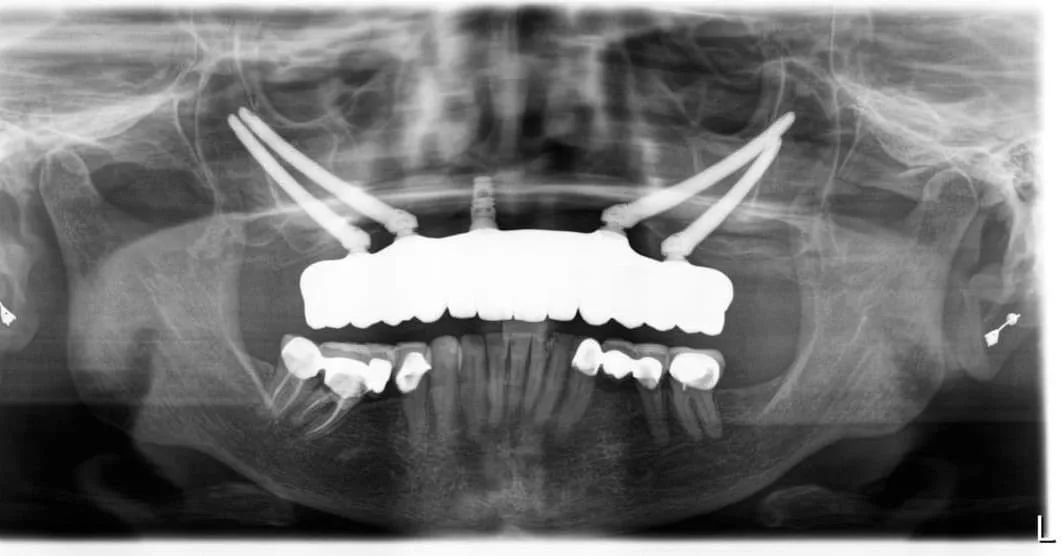
If you were told you need a bone graft first, the total treatment looks different on each path. The main comparison is a multicentre randomized trial of 71 patients: one group received zygomatic implants with immediate fixed teeth, the other a bone graft followed by conventional implants. It measured time, visits and complications, not money.
| In the trial | Zygomatic implants, immediate loading | Bone graft, then conventional implants |
|---|---|---|
| Path | Implants placed and, if firm enough, fixed provisional teeth within days | A grafting surgery, then implant surgery once the graft has healed, then teeth |
| Time to functional fixed teeth (average) | 1.34 days | 444.32 days |
| Dental visits up to one year after loading (average) | 15.12 | 19.72 (difference not statistically significant) |
| Prostheses that failed or could not be delivered at one year | 1 | 6 |
| Patients with complications at one year | 28 | 14 |
The latest Cochrane review, which for this comparison rests on that single trial, concludes that zygomatic implants probably have fewer implant failures than conventional implants in grafted bone, but probably more complications. In the trial's 4-month report, those complications resolved on their own or could be handled.
Grafting is not the wrong choice. In studies of five years or more, implants placed after a lateral-window sinus lift were lost at a rate of 0.43% per year. A sinus lift has its own complications; those that most often need treatment are sinus membrane perforation, wound opening, graft exposure or failure, and sinusitis. For someone flying in, each extra stage can mean another trip. Which path fits you depends on your CT, not on price.
Travel costs to plan for
If you are coming from abroad, add the trip to the treatment. Your number of trips and nights is set in your plan; these are the items to budget:
- Flights for the surgical trip and for a later trip to fit the final bridge.
- Lodging near Hospital CIMA in Escazú, from your evaluation until Dr. Torres clears you to fly.
- A changeable return ticket. A review on flying after dental treatment suggests at least 72 hours after uncomplicated implant placement and at least two weeks after a sinus lift. Zygomatic implants have not been studied; because they run through or alongside the sinus, we plan from the sinus guidance.
- A companion for the first days, and soft food.
- Time off work: in the randomized trial, patients with zygomatic implants reported on average 7.17 days of total and 12.17 days of partial impaired activity.
- Travel insurance: complications of elective treatment abroad are not always covered, so read your policy.
How we prepare your quote
- 01
Send your CT and history
A CT or CBCT that includes the upper jaw, sinuses and cheekbones, as DICOM files, plus photos and your medical and dental history. A recent panoramic X-ray is enough for a first look.
- 02
Consultation
Dr. Torres reviews your records and meets you by video or at our office in Tower 1 of Hospital CIMA, Escazú.
- 03
Written plan and exact quote
Your options and alternatives, the risks, the total treatment time and an exact quote for your plan, before you decide.
- 04
In-person confirmation
The in-person exam in Costa Rica confirms the plan before surgery.
Every surgery at our practice is led by Dr. Ronald Torres Labardini, an oral and maxillofacial surgeon certified by the Mexican Board of Oral and Maxillofacial Surgery, with his specialty from UNAM (Mexico, 2013). He has taught at the University of Costa Rica School of Dentistry since 2006 and is a member of the IAOMS.
«Claridad en explicar el diagnostico y los eventuales escenarios para proceder con el tratamiento a seguir» (Our translation: “Clarity in explaining the diagnosis and the possible scenarios for the treatment ahead.”) Maria R., HuliHealth, April 6, 2025. Dr. Torres holds 5.0 across 104 patient reviews on HuliHealth; they cover his oral and maxillofacial surgery practice in general, and none mention implants.
FAQ
Why don't you quote a price per implant?
Because the implant is only one part of the cost. A per-implant figure leaves out the bridge, the surgery, anesthesia, the CT and the follow-up, and the number of implants changes from one plan to another. What you need to compare is the total for your whole treatment, with teeth. Your exact quote is for the plan Dr. Torres proposes after evaluating your CT.
Why can't you give me a price before you see my CT?
Because the CT decides the plan. It shows how much bone remains in your upper jaw and cheekbones and whether your sinuses are healthy. That tells Dr. Torres whether two zygomatic implants with conventional implants in the front can work, or whether four zygomatic implants or other anchors are needed. A panoramic X-ray is enough for a first look, but not to set the plan.
Does a quad zygoma cost more than two zygomatic implants?
They are different treatments, so their quotes can't be compared line by line. Four zygomatic implants are indicated when there is no usable bone in the front of the jaw either and grafting is not feasible, predictable or preferred. In a meta-analysis, implant survival was 97.4% with four zygomatic implants and 98.6% with two zygomatic plus two conventional implants, with no statistically significant difference. Which one you need is decided on your CT, not by price.
Why does the quote mention two bridges?
Because there are two. The fixed provisional goes in within days when the implants are firm enough; the final bridge replaces it after healing (in the main randomized trial, 4 months after loading). A complete quote lists both and the material of each. Ask how repairs of the provisional are handled: in a long-term All-on-4 series, mechanical complications were far more frequent with provisional bridges (58.8%) than with final ones (7.3%).
Does insurance cover zygomatic implants?
It depends on your policy, so check with your insurer before you travel: ask whether it covers implant treatment abroad and which documents it needs, and tell us at your consultation. Travel insurance does not always cover complications of elective treatment abroad.
Are zygomatic implants cheaper in Costa Rica than in the US or Mexico?
Prices are quoted in such different ways that a quick comparison can mislead. Compare the total for the same treatment: the same number and type of implants, the same provisional and final bridge, the anesthesia and setting, the follow-up visits, plus flights and lodging. Then add the care you'll need back home: according to the ITI consensus, zygomatic implants and their bridges may require more professional maintenance.
How do payments work?
Payment methods and the payment schedule are discussed along with your quote. Wherever you are treated, ask in writing what is due before surgery, what is due when the final bridge is fitted, and in which currency.
What if an implant fails or the bridge breaks after I'm home?
Ask any practice to explain this in writing before you start. The annual risk of losing a zygomatic implant was estimated at 0.7%, and it may be higher in the first year (2%) than in later years (0.5% per year). The most common mechanical problems are loose or broken screws and abutments and chipped bridge teeth. If you have pain, swelling, bleeding, fever or a change in your vision, contact the office or go to an emergency service.
Sources
- 1.Al-Nawas B et al. — ITI consensus report on zygomatic implants: indications, evaluation of surgical techniques and long-term treatment outcomes. Int J Implant Dent, 2023.
- 2.Visconti RF et al. — Interventions for replacing missing teeth: zygomatic implants for the rehabilitation of the severely atrophic edentulous maxilla. Cochrane Database Syst Rev, 2026.
- 3.Davó R et al. — Immediately loaded zygomatic implants vs conventional dental implants in augmented atrophic maxillae: 1-year post-loading results from a multicentre randomised controlled trial. Eur J Oral Implantol, 2018.
- 4.Esposito M et al. — Immediately loaded zygomatic implants vs conventional dental implants in augmented atrophic maxillae: 4 months post-loading results from a multicentre randomised controlled trial. Eur J Oral Implantol, 2018.
- 5.Brennand Roper M et al. — Long-term treatment outcomes with zygomatic implants: a systematic review and meta-analysis. Int J Implant Dent, 2023.
- 6.Aboul-Hosn Centenero S et al. — Zygoma quad compared with 2 zygomatic implants: a systematic review and meta-analysis. Implant Dent, 2018.
- 7.Messias A et al. — Different interventions for rehabilitation of the edentulous maxilla with implant-supported prostheses: an overview of systematic reviews. Int J Prosthodont, 2021.
- 8.Patzelt SBM et al. — The all-on-four treatment concept: a systematic review. Clin Implant Dent Relat Res, 2014.
- 9.Shao WH et al. — All-on-4 and All-on-6 implant-supported fixed prostheses for the edentulous jaw: a systematic review and meta-analysis. Int J Oral Maxillofac Surg, 2026.
- 10.Maló P et al. — The All-on-4 concept for full-arch rehabilitation of the edentulous maxillae: a longitudinal study with 5-13 years of follow-up. Clin Implant Dent Relat Res, 2019.
- 11.Raghoebar GM et al. — Long-term effectiveness of maxillary sinus floor augmentation: a systematic review and meta-analysis. J Clin Periodontol, 2019.
- 12.Hsu YT et al. — Complications of sinus floor elevation procedure and management strategies: a systematic review. Clin Implant Dent Relat Res, 2022.
- 13.Felkai PP et al. — Dental tourism and the risk of barotrauma and barodontalgia. Br Dent J, 2023.
- 14.Australian Dental Association — Policy Statement 2.2.6: Elective Overseas Dental Treatment, 2023.
Schedule your consultation
Take the first step to your perfect smile today
We are here to answer your questions and guide you through the process.