
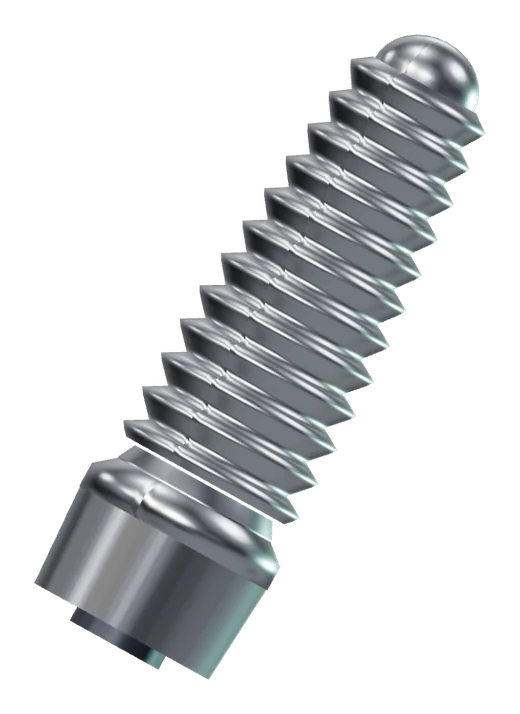
Anchors in: Where there is enough bone — placed with a surgical guide designed on your CT
Guided Conventional Implantology
In addition to our expertise in managing severe bone atrophy of the jaws, we also offer different solutions in conventional implantology. We offer everything from single implants to any of the multi-implant options, such as All-on-Six and All-on-Four.
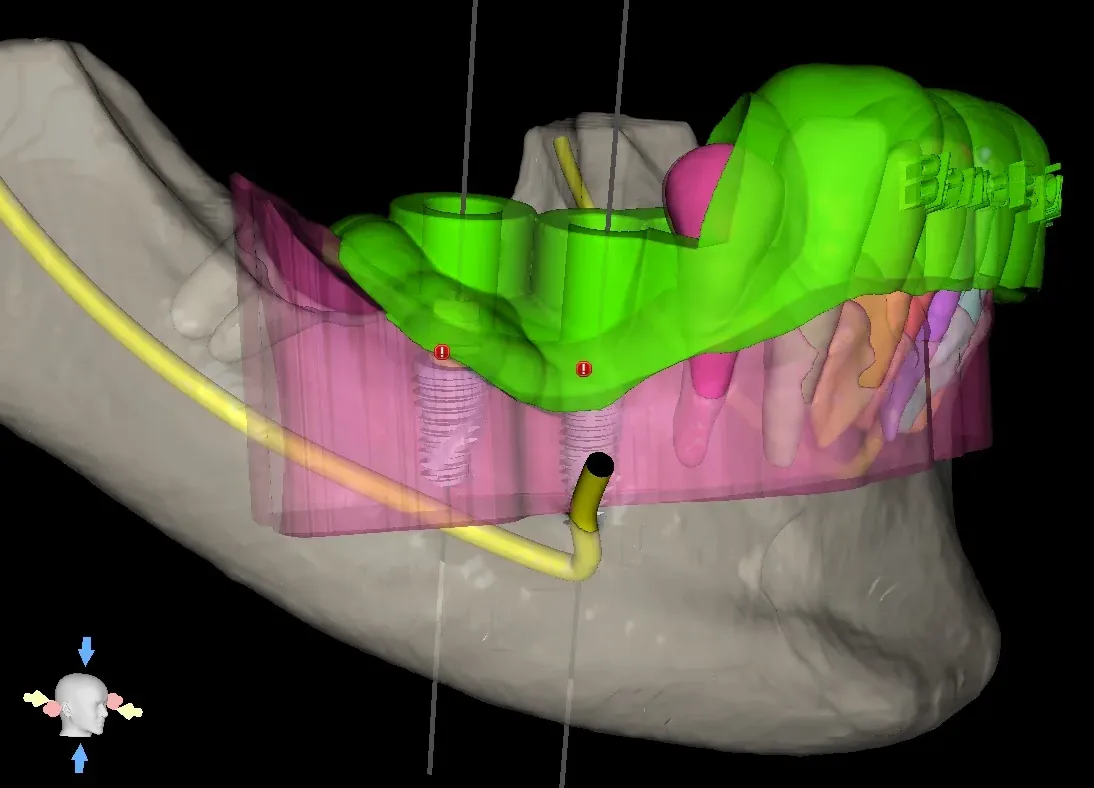
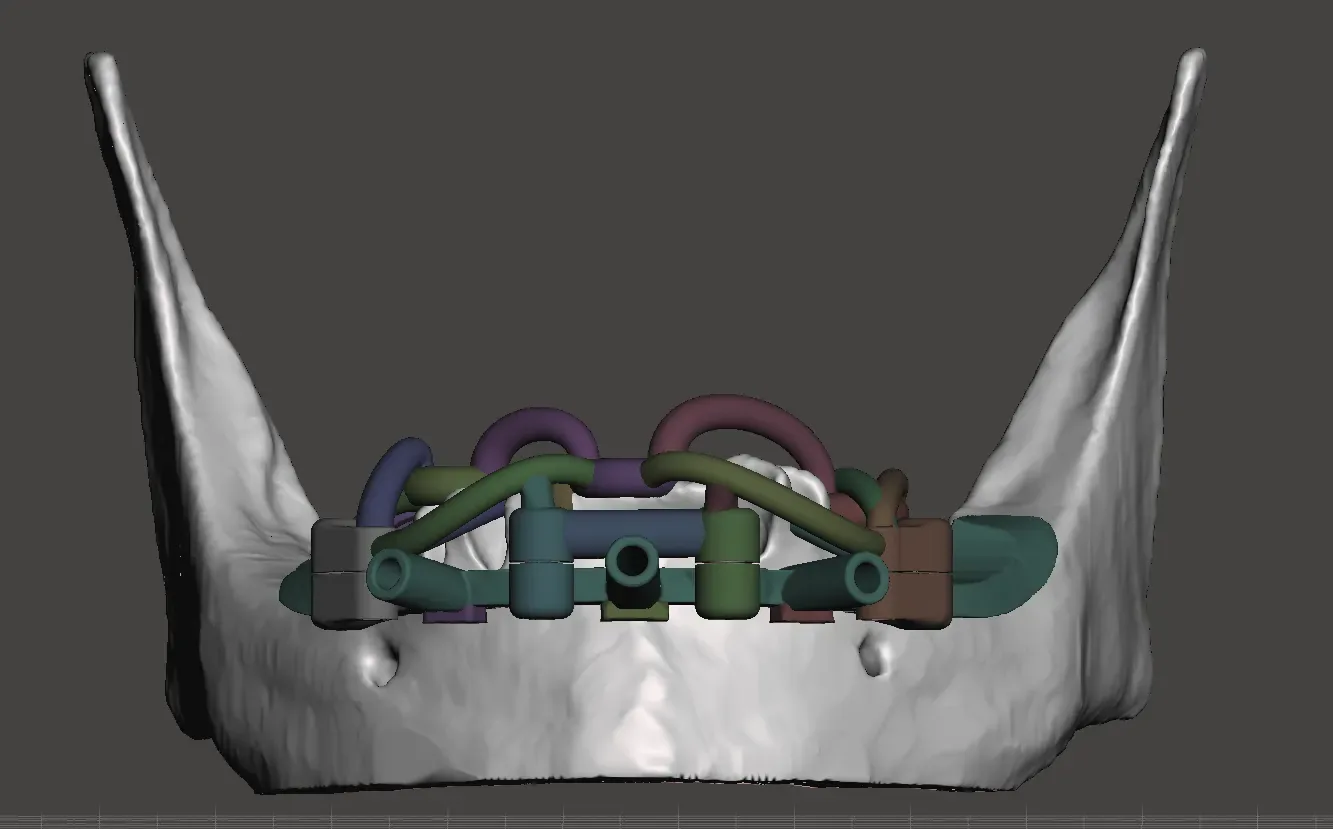
All our cases are digitally designed, and the implants are placed using placement guides. This approach provides a whole series of advantages, which we discuss below.
Guided Conventional Implantology
Why guided
- 01
Precision and safety
This is the most important advantage. By planning in 3D, the surgeon can “see” through the bone and gum. Safety: It allows for the identification and marking of vital anatomical structures (like the inferior alveolar nerve or the maxillary sinus). The surgical guide ensures the implant is placed at a safe distance from these structures, drastically reducing the risk of complications such as paresthesia (numbness of the lip) or sinusitis. Precision: It eliminates the guesswork and variability of freehand surgery. The implant follows the 3D-planned guide.
- 02
Minimally invasive surgery (“flapless”)
Since the surgeon knows with certainty where the bone is and where the implant will go, it is often not necessary to raise a large flap (cutting and separating the gum to see the bone). Flapless surgery: In many cases, the surgery can be performed by making only a small circular incision (a “punch”) in the gum, just the size of the implant. Less trauma: This means there are no large wounds, and often no need for sutures.
- 03
Better patient experience (post-operative)
As a direct consequence of being minimally invasive, the patient's recovery is much better. Less pain and swelling: Since there are no extensive cuts, post-operative swelling and pain tend to be lower. Faster recovery: The patient can return to their normal life much sooner. Shorter surgery: The procedure in the dental chair is significantly faster because all the planning is already done.
- 04
Ideal prosthetic results (“prosthetically-driven”)
This is a paradigm shift. Traditionally, implants were placed “where there was bone.” With guided surgery, the implant is placed in the ideal position for the future tooth (the crown). Better aesthetics and function: The implant emerges from the gum at the right angle and position so that the crown looks natural, functions correctly, and is easy to clean. Avoids prosthetic complications: It reduces long-term problems, such as metal exposure, difficulty with hygiene, or crown fracture due to poor force distribution.
Who it is for
- Missing one tooth, several or a full arch, with enough bone on your CT for conventional implants.
- You want a fixed full arch (All-on-4 or All-on-6) and your bone supports it.
- The site is close to the lower-jaw nerve, the sinus or neighboring roots, where planning on the CT matters most.
- Your general health is stable; well-controlled type 2 diabetes was not linked to more disease around implants.
- You will keep up daily cleaning and regular maintenance visits.
When it is not the right option
- Too little bone for conventional implants: then we evaluate short, pterygoid or zygomatic implants instead.
- Active gum disease or uncontrolled diabetes: treated or adjusted first, then the implants are planned.
- Teeth with a good prognosis: a systematic review warns against removing them just to place a full-arch prosthesis.
- High-dose bone medication for cancer, or past radiation to the jaws: these need a special evaluation with your physician and may rule implants out.
How we plan it on your CT
Every implant starts as a 3D plan. The American Academy of Oral and Maxillofacial Radiology recommends cross-sectional imaging for every implant site, with cone beam CT (CBCT) as the method of choice. On your scan we measure the bone and trace what the implant must avoid: the nerve canal of the lower jaw, the sinus and neighboring roots.
We plan backwards from the future tooth, and a surgical guide, a template that fits over your teeth or gums, carries that plan into surgery. The ITI consensus describes guided surgery as an additional tool within complete diagnosis and planning, not a replacement for them.
How precise is a surgical guide?
More precise than freehand placement, but not perfect. In a 2025 meta-analysis, the average deviation at the implant tip was 2.22 mm freehand, 0.88 mm with a fully guided approach and 1.36 mm with dynamic navigation; the angle deviated 7.46°, 2.57° and 3.67°, respectively.
An earlier meta-analysis found static guides more accurate when some teeth remain than in jaws with none, and its authors advise a safety margin of at least 2 mm. That margin is built into the plan around the nerve and other structures.
The day of surgery
Surgery follows the plan: the guide is seated, its fit is checked, and each drill passes through it to the planned depth and angle. When bone and gum allow it, the implant goes in through a small circular opening instead of a flap. When they don’t, Dr. Torres opens a conventional flap: the ITI consensus warns that flapless guided surgery can leave an implant outside the firm (keratinized) gum.
Local anesthesia is usual; whether you also receive sedation is decided at your evaluation. Pain control may matter most in the first 72 hours; in trials, anti-inflammatory drugs reduced pain versus placebo.
Provisional teeth and loading
A single crown usually goes on once the implant has bonded with the bone, on a timeline set after evaluation. On a full arch, a fixed provisional bridge can be attached within hours or days if every implant is firm enough; in a review of loading protocols, most studies recommended an insertion torque of at least 30 Ncm.
That provisional is the piece that breaks most often: in a long-term All-on-4 series in the upper jaw, mechanical complications affected 58.8% of provisional prostheses versus 7.3% of definitive ones. A soft diet protects it until the definitive prosthesis replaces it.
Why a maxillofacial surgeon plans and places it
Reading a CT for nerves, sinus and bone is daily work for an oral and maxillofacial surgeon. Every surgery at our practice is led by Dr. Ronald Torres Labardini, who completed his oral and maxillofacial surgery specialty at the National Autonomous University of Mexico (UNAM) in 2013 and is certified by the Mexican Board of Oral and Maxillofacial Surgery.
He has taught at the University of Costa Rica School of Dentistry since 2006 and is a member of the IAOMS. If the bone differs from what the CT suggested, the surgeon who made the plan decides how to proceed. He sees patients in Tower 1 of Hospital CIMA, in Escazú, and holds a 5.0 rating across 104 HuliHealth reviews of his surgical practice.
From consultation to final teeth
- First contactWrite to us. If you have a recent CT scan, send it.
- Evaluation, CT and planClinical exam, medical history and a CBCT scan; gum disease or uncontrolled diabetes is treated first. You receive the plan and its cost before deciding.
- SurgeryDr. Torres places the implants through the guide; on a full arch, a fixed provisional follows if every implant is stable enough.
- HealingSoft diet and follow-up for a period set after evaluation. Expert advice suggests at least 72 hours before flying after uncomplicated implant placement.
- Final teethThe definitive crown, bridge or full arch, then regular maintenance visits.
Guided Conventional Implantology
Risks and how we manage them
Every surgery carries risks. These are the real ones for this technique, and what we do about each.
- Nerve or sinus injury
- Too close to the lower-jaw nerve, an implant can cause numbness of the lip or chin; in the upper jaw, the sinus can be affected. Prevention: CBCT, tracing the nerve and the sinus on the plan, the 2 mm margin and checking the guide’s fit before drilling. Management depends on the structure involved. If numbness persists after the anesthesia wears off, contact our office right away.
- Early implant failure
- Sometimes an implant does not bond with the bone; in smokers, the risk of early failure was double, counted per patient. Prevention: no smoking, controlled diabetes and a preventive antibiotic when the surgeon indicates it (a Cochrane review found it reduced failures). A failed implant is removed, and a new one is evaluated after healing.
- Pain, swelling and bruising
- Expected in the first days and managed with medication, cold and a soft diet. If they get worse after the third day, or you have a fever, call our office; in an emergency, go to the nearest emergency service.
- Peri-implantitis over the years
- Inflammation with bone loss around implants affected 21% to 25.0% of patients, depending on the review. Regular maintenance visits are linked to a lower risk; caught early, it is treated with professional cleaning and, if it progresses, surgery.
FAQ
Need more info?
Contact us to get answers or schedule your dental implant consultation.
Does guided surgery mean no incision and no stitches?
Not always. When bone and gum allow it, the implant goes in through a small circular opening, often without stitches; when the firm gum has to be preserved or the bone seen directly, a conventional flap is safer. We decide on your CT and at the clinical exam.
Will I have less pain and swelling with a guide?
Possibly, but we won’t promise it. The ITI consensus considered guided surgery beneficial for pain and discomfort, while a meta-analysis of randomized trials found no clear difference in perceived discomfort (low-quality evidence).
Do guided implants last longer?
Survival is high either way. In randomized trials, survival up to 12 months after loading was above 98% and comparable for guided and freehand placement (low-quality evidence); a review of fully guided placement reported 97% cumulative survival. Over the years, maintenance and not smoking matter most.
Does guided surgery cost more?
The guide is part of planning. A plan’s cost depends on how many implants you need, any extractions and the type of crown, bridge or full arch; your exact quote comes after we evaluate your CT.
How many trips to Costa Rica will I need?
We confirm it after evaluating your CT. Surgery and the definitive teeth are usually separate stages, because the implants must bond with the bone first. Expert advice, based on scarce evidence, suggests at least 72 hours before flying after uncomplicated implant placement and at least two weeks after a sinus lift.
What if my CT shows there isn’t enough bone?
Then we evaluate the techniques designed for less bone: short, pterygoid or zygomatic implants, planned on the same CT. Those graftless techniques are the focus of our practice.
How is the surgery planned?
We merge your photographs, intraoral scan and 3D CT scan into a virtual model of your anatomy, perform the surgery virtually with millimeter-level accuracy, and fabricate custom surgical guides so each implant goes exactly where it was planned.
Will I be awake? Does it hurt?
Most surgeries are outpatient, under local anesthesia with IV sedation, so you are relaxed and feel no pain during the surgery. A physician anesthesiologist monitors your vital signs throughout. Complex cases are done in the hospital under general anesthesia, and we coordinate your transportation.
How much does it cost?
Every case is different, so the plan — and its cost — is defined after your evaluation and CT scan. Write to us and we will guide you through the first step.
Sources
- 1.Werny JG et al. — Freehand vs. computer-aided implant surgery: a systematic review and meta-analysis-part 1: accuracy of planned and placed implant position. Int J Implant Dent, 2025.
- 2.Tahmaseb A et al. — The accuracy of static computer-aided implant surgery: A systematic review and meta-analysis. Clin Oral Implants Res, 2018.
- 3.Tattan M et al. — Static computer-aided, partially guided, and free-handed implant placement: A systematic review and meta-analysis of randomized controlled trials. Clin Oral Implants Res, 2020.
- 4.Wismeijer D et al. — Group 5 ITI Consensus Report: Digital technologies. Clin Oral Implants Res, 2018.
- 5.Aghaloo T et al. — Guided and Navigation Implant Surgery: A Systematic Review. Int J Oral Maxillofac Implants, 2023.
- 6.Tyndall DA et al. — Position statement of the American Academy of Oral and Maxillofacial Radiology on selection criteria for the use of radiology in dental implantology with emphasis on cone beam computed tomography. Oral Surg Oral Med Oral Pathol Oral Radiol, 2012.
- 7.Papaspyridakos P et al. — Implant loading protocols for edentulous patients with fixed prostheses: a systematic review and meta-analysis. Int J Oral Maxillofac Implants, 2014.
- 8.Maló P et al. — The All-on-4 concept for full-arch rehabilitation of the edentulous maxillae: A longitudinal study with 5-13 years of follow-up. Clin Implant Dent Relat Res, 2019.
- 9.Kwon T et al. — Systematic review of short- (5-10 years) and long-term (10 years or more) survival and success of full-arch fixed dental hybrid prostheses and supporting implants. J Dent, 2014.
- 10.Fan YY et al. — Smoking in relation to early dental implant failure: A systematic review and meta-analysis. J Dent, 2024.
- 11.Esposito M et al. — Interventions for replacing missing teeth: antibiotics at dental implant placement to prevent complications. Cochrane Database Syst Rev, 2013.
- 12.Bencze B et al. — Prediabetes and poorly controlled type-2 diabetes as risk indicators for peri-implant diseases: A systematic review and meta-analysis. J Dent, 2024.
- 13.Khouly I et al. — Post-operative pain management in dental implant surgery: a systematic review and meta-analysis of randomized clinical trials. Clin Oral Investig, 2021.
- 14.Reis INRD et al. — The prevalence of peri-implant mucositis and peri-implantitis based on the world workshop criteria: A systematic review and meta-analysis. J Dent, 2025.
- 15.Galarraga-Vinueza ME et al. — Prevalence, incidence, systemic, behavioral, and patient-related risk factors and indicators for peri-implant diseases: An AO/AAP systematic review and meta-analysis. J Periodontol, 2025.
- 16.Carra MC et al. — Primordial and primary prevention of peri-implant diseases: A systematic review and meta-analysis. J Clin Periodontol, 2023.
- 17.Schimmel M et al. — Effect of advanced age and/or systemic medical conditions on dental implant survival: A systematic review and meta-analysis. Clin Oral Implants Res, 2018.
- 18.Felkai PP et al. — Dental tourism and the risk of barotrauma and barodontalgia. Br Dent J, 2023.
Schedule your consultation
Take the first step to your perfect smile today
We are here to answer your questions and guide you through the process.