
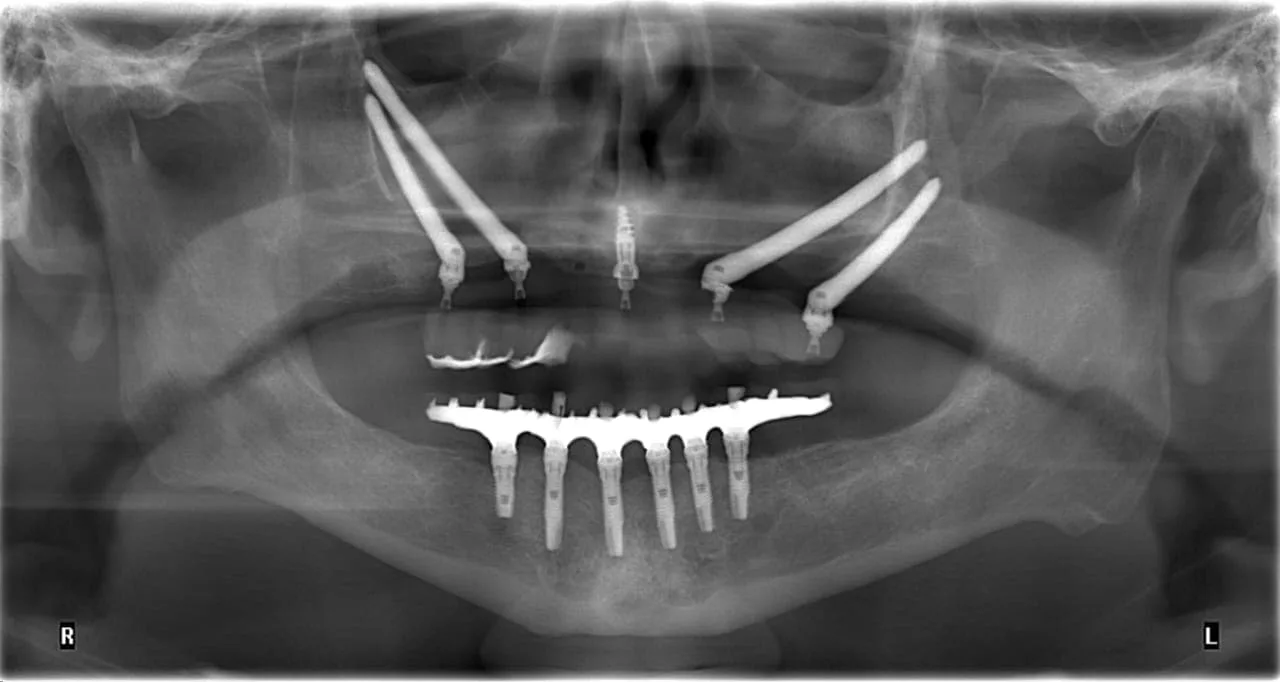
If you were told you don't have enough bone for implants, you have probably heard two names: All-on-4 and zygomatic implants. They are often presented as rivals, but they answer different questions. All-on-4 describes how a full fixed bridge is held: four implants in one jaw, the back ones tilted. Zygomatic implants describe where an implant is anchored: in the cheekbone, when the upper jaw itself has too little bone. Which one you need depends on how much bone you have left, and where.
All-on-4 and zygomatic implants are not opposites
In a conventional All-on-4, four standard implants go into the jaw and carry one fixed bridge for the whole arch. The front implants stand upright; the back implants are tilted so they can use the bone that is still there and avoid a bone graft. It can be done in the upper or the lower jaw, as long as the bone can hold all four implants.
A zygomatic implant is a much longer implant that starts in the area of the back teeth, runs along the side of the upper jaw and anchors in the zygomatic bone, the cheekbone. It is used only in the upper jaw. It carries the same kind of fixed full-arch bridge, so the two ideas often meet: a plan with two zygomatic implants in the back and conventional implants in the front is sometimes called a “zygoma All-on-4”. When the front has no usable bone either, four zygomatic implants can carry the bridge on their own.
How tilted implants avoid a graft, and how well they hold up
Tilting the back implants is what lets All-on-4 skip a sinus lift in many people. An umbrella review with meta-analysis found no significant difference in implant failure between tilted and straight (axial) implants.
For All-on-4 itself, a 2026 systematic review found that 98.14% of implants were still in place at five years or more, with mechanical complications in 5.91% and biological complications in 6.54%. An overview of systematic reviews reports cumulative survival between 94.8% and 99.3%, depending on the review. An earlier review found that most implant failures (74%) happened within the first 12 months, and that the main prosthetic complication was fracture of all-acrylic bridges.
The provisional bridge is the part that needs the most care. In a long-term series on the upper jaw from the clinic that developed the technique, mechanical complications occurred with 58.8% of provisional bridges and 7.3% of definitive bridges, and smoking was associated with implant loss.
When a conventional All-on-4 is not possible
All-on-4 needs bone where the implants go. After years without teeth, or years of wearing a denture, the upper jaw can lose so much bone that there is not enough height in the back, and sometimes not in the front either. The ITI consensus on zygomatic implants asks that bone loss be measured with objective criteria; the most cited classification is Cawood and Howell, classes IV, V and VI. The same consensus lists the main reasons to choose zygomatic implants:
- A severely resorbed or deficient upper jaw.
- Grafts or implants that have already failed.
- Wanting to avoid staged bone grafting.
- Conditions that complicate a traditional bone graft, such as benign cysts or trauma.
An overview of systematic reviews concluded that no implant rehabilitation of the toothless upper jaw should rest on fewer than four implants, so fewer implants is not the answer when bone is short. And “no bone” usually means no bone for a standard implant: in borderline cases with some bone left, a 2026 review recommends considering less invasive options, such as short or tilted implants, bone regeneration or a custom subperiosteal implant. Another systematic review warns that teeth with a good prognosis should not be removed just to place a full-arch hybrid bridge.
The only way to know is imaging. The ITI consensus recommends a CT or CBCT scan that includes the midface, to measure the bone in the upper jaw and cheekbones and to check that your sinuses are healthy before surgery.
Two zygomatic plus front implants, or quad zygoma?
If the back of the upper jaw lacks bone but the front still has some, the usual plan combines two zygomatic implants, one on each side, with conventional implants in the front. If there is no usable bone in the front either, and a graft is not feasible, predictable or what you prefer, the ITI consensus says four zygomatic implants (quad zygoma) can be indicated, with all the implants joined by the bridge. For a severely resorbed front, transnasal implants have also been proposed as front anchorage instead of a quad zygoma; that evidence comes from case series.
A meta-analysis comparing both designs found implant survival of 97.4% with four zygomatic implants and 98.6% with two zygomatic plus two conventional implants, with no statistically significant difference. Another meta-analysis of quad zygoma found pooled survival of 98%, but complications were not negligible: sinusitis 12%, malposition or surgical guide failure 11%, local infection or injury 10%, and prosthetic complications 5%.
Survival by the evidence, and how to read it
Zygomatic implants hold up well over time in published studies. A systematic review with meta-analysis found mean survival of 96.2% at six years. In studies with at least five years of follow-up, mean survival was 96.5% for zygomatic implants and 95.8% for conventional implants, with no statistically significant difference. A review of 4,556 zygomatic implants estimated 12-year cumulative survival at 95.21%, with most failures within six months of surgery. The ITI consensus notes that the risk of losing one may be higher in the first year (2%) than in later years (0.5% per year).
Read these figures side by side with care. People who receive zygomatic implants usually start with much less bone than people who receive a conventional All-on-4, and the ITI consensus still lists randomized trials comparing zygomatic implants with distally tilted implants, short implants and staged grafts as research that is needed. What it does state is that zygomatic implant survival appears comparable to that of conventional implants used in the resorbed upper jaw, including tilted implants and implants in grafted sinuses. These are averages from studies, not a prediction for any one person.
Where the two differ most: surgery and complications
Survival is similar; the surgery is not. Zygomatic implants are considered a complex treatment, and their success depends heavily on the surgeon's skill and experience. Sinusitis is the most commonly reported biological complication, and the figures vary widely by study and technique: from 2.4% in a large review to 14.2% at five years in a long-term review. An umbrella review warns that complications may be underestimated because the included studies differ so much. Zygomatic implants and their bridges may also need more professional maintenance, and there are limits to the chewing loads they should take.
All-on-4 has its own trade-offs: the provisional bridge has problems far more often than the final one, and mechanical and biological complications are part of long-term care.
Quality of life: what the randomized trials found
Two randomized trials have compared the approaches in people with toothless, resorbed upper jaws, and they do not agree. In one, with 80 patients, those who received zygomatic implants with front implants reported better quality of life and were more satisfied with their bridge than those who received All-on-4. In the other, with thirty-six patients, satisfaction did not differ between the groups, except satisfaction with the surgical procedure and the healing period.
What changes the cost
We don't publish a single price, because your plan decides it. A full arch on four conventional implants, a combined plan and a quad zygoma differ in the number and type of implants, and other items change the total: extractions, the fixed provisional bridge, the material of the final bridge, the anesthesia and the setting, follow-up visits, and travel if you come from abroad. Our cost page explains what a complete quote should list. Your exact quote comes after Dr. Torres evaluates your CT.
How we help you decide
The ITI consensus asks that each case be analyzed individually and that the options be discussed with the patient: risks, benefits, the final result, total treatment time, long-term outcomes and preferences. That is how we work: you send your CT or CBCT and your history, Dr. Torres reviews them with you by video or at our office in Tower 1 of Hospital CIMA, in Escazú, and you receive a written plan with your options before you decide anything. If an All-on-4 on conventional implants fits your bone, that is what we will tell you.
Every surgery at our practice is led by Dr. Ronald Torres Labardini, an oral and maxillofacial surgeon certified by the Mexican Board of Oral and Maxillofacial Surgery, with his specialty from UNAM (Mexico, 2013). He has taught at the University of Costa Rica School of Dentistry since 2006 and is a member of the IAOMS. His Hospital CIMA profile lists immediate hybrid-prosthesis implants, All-on-4 (immediate implant rehabilitation) and sinus lift.
«El doctor se tomó el tiempo suficiente para explicarme a fondo mi caso, de modo que yo entendiera plenamente lo que me estaba sucediendo» (“The doctor took enough time to explain my case to me thoroughly, so that I fully understood what was happening to me”). Oscar S., HuliHealth, March 26, 2023. Dr. Torres holds 5.0 across 104 patient reviews on HuliHealth; they cover his oral and maxillofacial surgery practice in general, and none mention implants.
If you already have implants or a full-arch bridge and notice pain or swelling that gets worse, fever, a bridge that moves, or liquid coming out of your nose when you drink, contact your surgeon or our office promptly. If symptoms are severe, go to the nearest emergency service.
FAQ
Can All-on-4 be done with zygomatic implants?
Yes. All-on-4 is a way of holding a full fixed bridge on four implants. When the back of the upper jaw lacks bone, two zygomatic implants can take the place of the tilted back implants while conventional implants stay in the front; when the front lacks bone too, four zygomatic implants (quad zygoma) can carry the bridge, all joined together. A meta-analysis found no statistically significant difference in survival between the two designs: 97.4% with four zygomatic implants and 98.6% with two zygomatic plus two conventional implants.
I was told I don't have enough bone for All-on-4. What now?
Ask what “not enough” means: in the back, in the front or both, and for which kind of implant. A CT or CBCT scan that includes the midface answers that. In borderline cases, less invasive options such as short or tilted implants, bone regeneration or a custom subperiosteal implant should also be considered. Our candidate page walks you through it, and Dr. Torres can review your CT by video.
Which lasts longer, All-on-4 or zygomatic implants?
Both show high survival in published reviews: 98.14% of All-on-4 implants at five years or more in one meta-analysis, and 96.2% of zygomatic implants at six years in another. They were not measured in the same patients, so the figures can't be ranked; zygomatic implants are usually placed in people with much less bone. With both, regular maintenance is part of keeping them.
Are zygomatic implants riskier than All-on-4?
The surgery is more complex, and its success depends heavily on the surgeon's skill and experience. Sinusitis is the complication reported most often, from 2.4% to 14.2% at five years depending on the study and technique. All-on-4 has complications too, mostly with the bridge: in one long-term series, mechanical complications occurred with 58.8% of provisional bridges. Your written plan covers the risks of each option for your case.
Can zygomatic implants be used in the lower jaw?
No. They anchor in the cheekbone, so they are only for the upper jaw. If your lower jaw also needs a full arch, it is planned separately, with other techniques such as conventional implants.
Do I get fixed teeth right away with either option?
When the implants are firm enough at placement, yes. In a review of All-on-4 studies, 1,201 fixed bridges were placed within 48 hours of surgery. In a randomized trial of zygomatic implants, fixed teeth required an insertion torque above 40 Ncm, and patients had functional fixed teeth after 1.34 days on average. If an implant is not firm enough, the teeth wait until it heals.
Sources
- 1.Malak AA et al. — Implant failure and marginal bone loss between axial and tilted implants: an umbrella review with meta-analysis. Int J Oral Maxillofac Implants, 2024.
- 2.Shao WH et al. — All-on-4 and All-on-6 implant-supported fixed prostheses for the edentulous jaw: a systematic review and meta-analysis. Int J Oral Maxillofac Surg, 2026.
- 3.Figueiredo CE et al. — Rehabilitation of edentulous jaws using the “All-on-Four” treatment concept: an overview of systematic reviews. Oral Maxillofac Surg, 2025.
- 4.Patzelt SBM et al. — The all-on-four treatment concept: a systematic review. Clin Implant Dent Relat Res, 2014.
- 5.Maló P et al. — The All-on-4 concept for full-arch rehabilitation of the edentulous maxillae: a longitudinal study with 5-13 years of follow-up. Clin Implant Dent Relat Res, 2019.
- 6.Al-Nawas B et al. — ITI consensus report on zygomatic implants: indications, evaluation of surgical techniques and long-term treatment outcomes. Int J Implant Dent, 2023.
- 7.Messias A et al. — Different interventions for rehabilitation of the edentulous maxilla with implant-supported prostheses: an overview of systematic reviews. Int J Prosthodont, 2021.
- 8.Acerra A et al. — Zygomatic implants for rehabilitation of the atrophic maxilla: clinical indications, outcomes, complications, and evidence gaps — a comprehensive review. Medicina (Kaunas), 2026.
- 9.Kwon T et al. — Systematic review of short- (5-10 years) and long-term (10 years or more) survival and success of full-arch fixed dental hybrid prostheses and supporting implants. J Dent, 2014.
- 10.Eshoiee N et al. — Trans-nasal dental implants: indication and the report of 10 cases. Ann Med Surg (Lond), 2025.
- 11.Aboul-Hosn Centenero S et al. — Zygoma quad compared with 2 zygomatic implants: a systematic review and meta-analysis. Implant Dent, 2018.
- 12.Lan K et al. — Quad zygomatic implants: a systematic review and meta-analysis on survival and complications. Int J Oral Maxillofac Implants, 2021.
- 13.Brennand Roper M et al. — Long-term treatment outcomes with zygomatic implants: a systematic review and meta-analysis. Int J Implant Dent, 2023.
- 14.Moraschini V et al. — Survival and complications of zygomatic implants compared to conventional implants reported in longitudinal studies with a follow-up period of at least 5 years: a systematic review and meta-analysis. Clin Implant Dent Relat Res, 2023.
- 15.Chrcanovic BR et al. — Survival and complications of zygomatic implants: an updated systematic review. J Oral Maxillofac Surg, 2016.
- 16.D’Ambrosio F et al. — Clinical risk and medico-legal implications in zygomatic implant rehabilitation: an umbrella review of systematic reviews. Diagnostics (Basel), 2026.
- 17.Fernández-Ruiz JA et al. — Evaluation of quality of life and satisfaction in patients with fixed prostheses on zygomatic implants compared with the All-on-Four concept: a prospective randomized clinical study. Int J Environ Res Public Health, 2021.
- 18.Nagib MA et al. — Evaluation of quality of life and satisfaction with fixed prostheses on zygomatic implants vs All-on-Four concept: a randomized clinical study. J Contemp Dent Pract, 2024.
- 19.Davó R et al. — Immediately loaded zygomatic implants vs conventional dental implants in augmented atrophic maxillae: 1-year post-loading results from a multicentre randomised controlled trial. Eur J Oral Implantol, 2018.
- All-on-4
- Zygomatic implants
- Quad zygoma
- Severe bone loss