
Anchors in: On the surface of the remaining bone, under the gum
Custom Subperiosteal Implants
If the regular management options for severe atrophy cases cannot be resolved using zygomatic, pterygoid, or transnasal implant techniques, custom subperiosteal implants are the next option.
This type of implant is a solution for very specific cases of bone loss. Unlike a traditional implant that goes inside the bone (endosseous), the subperiosteal implant is a custom-designed titanium structure or mesh that sits directly on the surface of the maxillary or mandibular bone, just beneath the gum (the periosteum).
This mesh is fabricated using the patient’s tomography (CT scan) and 3D design (CAD/CAM) to fit their anatomy.
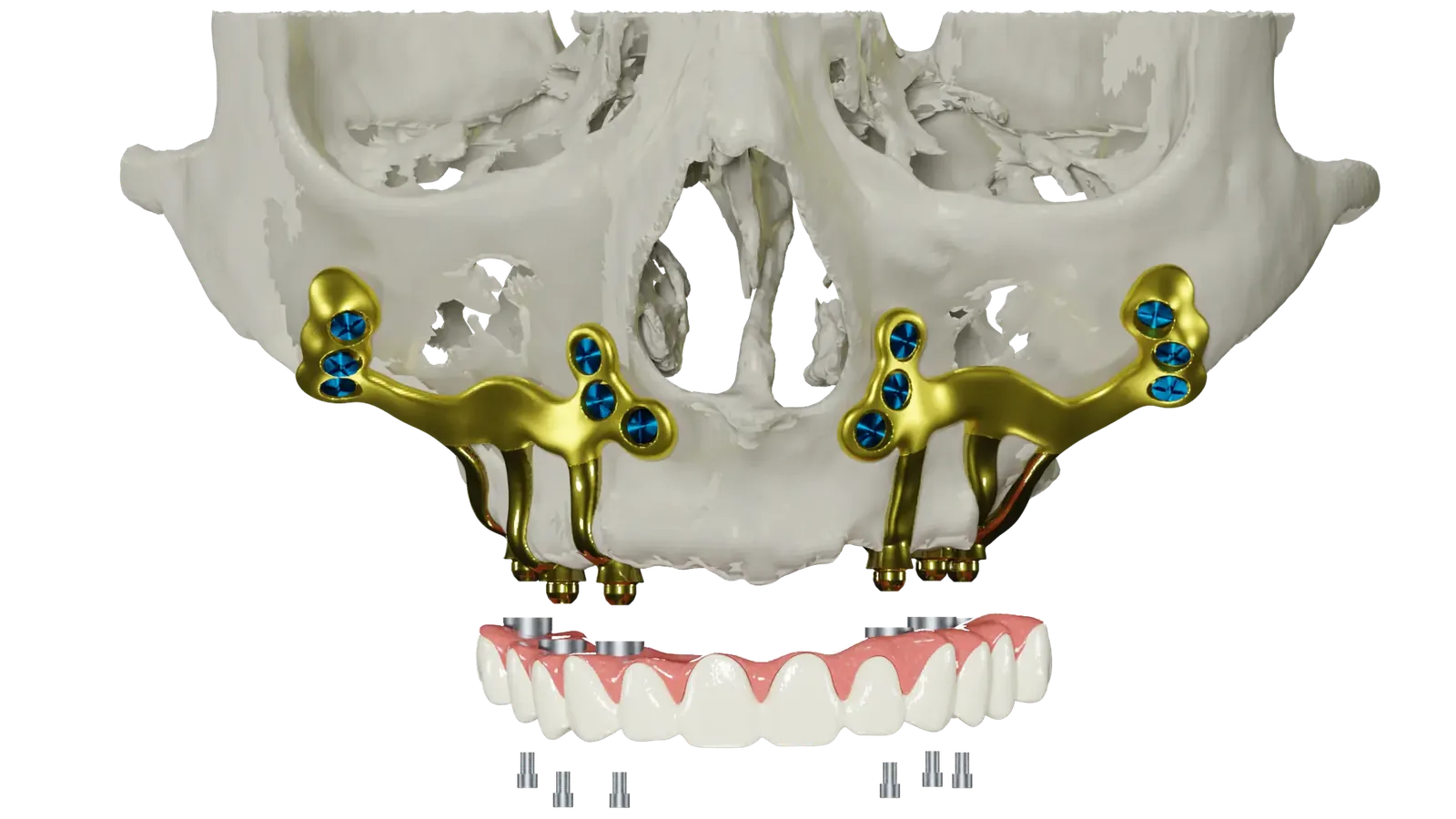
Custom Subperiosteal Implants
How it is made
- 01
Your CT scan
The framework starts from the patient’s tomography (CT scan).
- 02
3D design (CAD/CAM)
It is designed in 3D to fit the anatomy.
- 03
On the bone, not inside it
The titanium structure sits directly on the surface of the bone, just beneath the gum (the periosteum).
Who it is for
- Severe bone loss in the upper or lower jaw, where conventional implants would require major reconstructive surgery.
- Cases that zygomatic, pterygoid or transnasal implants cannot solve.
- Severe atrophy of the lower jaw, where zygomatic implants (anchored in the cheekbone) do not apply.
- Older adults, or people whose health makes a long, multi-stage bone reconstruction a poor fit, after a medical evaluation.
- People ready to commit to daily hygiene and regular check-ups.
When it is not the right option
- Enough bone for conventional, short or tilted implants, or for zygomatic implants, which have more long-term evidence.
- Smokers who cannot stop: across 107 studies of dental implants, 6.35% of implants failed in smokers versus 3.18% in non-smokers.
- High-dose antiresorptive medication for bone metastases, or previous radiation therapy: both affect results and need a specific evaluation first.
- Not being able to keep up with home care and check-ups: gum problems over the framework are the main cause of late failure.
How we plan it: your CT scan and a 3D design
Planning starts with a CT scan of your jaws. Dr. Torres studies the remaining bone in 3D, defines where the framework will rest and where the posts that hold your teeth will come through the gum, and plans the prosthesis together with the surgery.
The framework is then designed on a computer to match your bone and manufactured in titanium. Manufacturing takes time, so surgery is scheduled once the framework is ready. In a published cohort of 211 custom implants, every case was planned digitally.
What the evidence says, honestly
Custom subperiosteal implants are less studied than zygomatic implants, and most follow-up is short. A 2026 systematic review reported 97.8% survival in studies of up to 3 years and 92.4% with all studies pooled; the longest study, at 6 years, reported 54.1%. Another review, of 368 implants, reported 87.8%; a single-center cohort of 211 implants, 98.1% at a median of 28 months.
The 2026 review notes that gum problems over the framework are the main cause of late failure, that survival alone overestimates clinical success, and that these implants should be considered a salvage option for carefully selected patients. That is how we use them: when other graftless techniques cannot solve the case.
The day of surgery and your provisional teeth
Through an opening in the gum, Dr. Torres seats the framework on the bone, fixes it with screws and closes the gum over it, leaving only the posts exposed. Anesthesia and the setting are defined in your plan and explained beforehand.
Studies describe immediate rehabilitation with these implants: a fixed provisional prosthesis connected soon after surgery. Whether that applies to you, and when, is confirmed in your plan. While you heal, you eat soft foods and keep the area clean; the final prosthesis comes later, on a timeline set after evaluation.
Why a maxillofacial surgeon leads it
With severe atrophy the remaining bone is thin and the gum over the framework must heal well; planning around that bone and managing complications is the daily work of oral and maxillofacial surgery.
Dr. Ronald Torres Labardini completed his oral and maxillofacial surgery specialty at the National Autonomous University of Mexico (UNAM) in 2013, is certified by the Mexican Board of Oral and Maxillofacial Surgery (Consejo Mexicano de Cirugía Oral y Maxilofacial) and has been a professor at the University of Costa Rica School of Dentistry since 2006. He is an IAOMS member and was a speaker at the AO CMF course “Advances in maxillo-mandibular reconstruction” (San José, 2014). He leads every surgery at our practice in Tower 1 of Hospital CIMA, Escazú, and holds a 5.0 rating across 106 HuliHealth reviews of his surgical practice.
From consultation to final teeth
- First contactSend your questions and any X-rays or CT scans you have; Dr. Torres gives you a first opinion by message or video consultation.
- Evaluation and CT scan in Costa RicaAn in-person exam and a CT scan confirm whether a custom framework is right for you, the alternatives and the cost. The exact quote comes after the CT is evaluated.
- Design, manufacturing and surgeryThe framework is designed from your CT and manufactured in titanium; surgery follows once it is ready, with fixed provisional teeth soon after when your plan allows it.
- Healing, final teeth and check-upsAfter healing, your final prosthesis replaces the provisional, on a timeline set after evaluation. Regular check-ups continue for as long as you have the implant.
Custom Subperiosteal Implants
Risks and how we manage them
Every surgery carries risks. These are the real ones for this technique, and what we do about each.
- Part of the framework showing through the gum
- The most frequent problem, with figures that vary widely: 9.5% of implants in a cohort of 211 (almost all of the mildest grade, usually without symptoms), 25.6% and 37% in two reviews, and 28.6% dehiscence in another. Prevention: a design that respects the soft tissue, careful closure, daily hygiene and check-ups. Management ranges from local care to a minor gum procedure.
- Losing the implant
- Reported survival ranges from 87.8% to 98.1% across reviews and cohorts, most with short follow-up; the only 6-year study reported 54.1%. In one review, upper-jaw implants had a 3.8-fold higher hazard of failure than lower-jaw ones. Careful case selection is the main prevention; a failed implant is removed and the treatment replanned.
- Soft-tissue infection
- In one review, 5.3% of patients had a soft-tissue or persistent infection. Hygiene, not smoking and check-ups help prevent it; treatment depends on the case.
- Pain and swelling
- One review reported pain (25%) and swelling (24%) as early complications; a cohort described delayed swelling without pus, mostly in the upper jaw, that generally resolved on its own or with conservative treatment. If swelling keeps increasing, or you have a fever or bleeding that does not stop, contact our office right away or go to the nearest emergency service.
- Fracture of the provisional teeth
- In one review, 5.2% of patients with a reported provisional prosthesis had a fracture of it. A soft diet while you heal takes load off it; if it breaks, it is repaired.
FAQ
Need more info?
Contact us to get answers or schedule your dental implant consultation.
How are today’s custom subperiosteal implants different from older ones?
The studies we cite cover only today’s frameworks: designed on a computer from a CT scan and manufactured in titanium, often by 3D printing, to fit each patient’s anatomy. These studies are recent, and most have short follow-up, so long-term results are still being measured.
Can subperiosteal implants be used in the lower jaw?
Yes. They are used in both jaws, which matters because zygomatic implants anchor in the cheekbone and only serve the upper jaw. In one review, lower-jaw implants failed less often than upper-jaw ones, though that may partly reflect more severe upper-jaw cases.
Subperiosteal or zygomatic implants: which is right for me?
It depends on your anatomy. In the upper jaw, zygomatic implants have more long-term evidence, so we consider them first, along with pterygoid and transnasal implants. A custom subperiosteal framework is the next option when those cannot solve the case, or when the bone loss is in the lower jaw.
How long do custom subperiosteal implants last?
No one can promise a lifespan. Survival is high in the first years (97.8% in studies of up to 3 years, in a 2026 review), but the only 6-year study reported 54.1%. Gum problems over the framework are the main cause of late failure, so hygiene and check-ups matter.
What should I do if I see metal through my gum?
Contact our office and send us a photo. Small exposures are common and, in one cohort, usually caused no symptoms, but they should be checked early. If there is pain, swelling or pus, contact us promptly or go to the nearest emergency service.
How long will I need to stay in Costa Rica?
It depends on your plan; we give you the schedule after your evaluation. When it is safe to fly is decided at your post-operative check-up, case by case: evidence on flying after dental surgery is scarce.
I was told I don’t have enough bone for implants. Can I still get fixed teeth?
Very often, yes — that is exactly the kind of case we focus on. Instead of grafting, techniques such as zygomatic and pterygoid implants anchor directly into your own basal bone (in areas like the cheekbones or the posterior upper jaw). We confirm which option fits you after a clinical evaluation and a CT scan.
How is the surgery planned?
We merge your photographs, intraoral scan and 3D CT scan into a virtual model of your anatomy, perform the surgery virtually with millimeter-level accuracy, and fabricate custom surgical guides so each implant goes exactly where it was planned.
How much does it cost?
Every case is different, so the plan — and its cost — is defined after your evaluation and CT scan. Write to us and we will guide you through the first step.
Sources
- 1.Cosola S et al. — Clinical Outcomes, Survival, and Complications of Customized Computer-Aided Design and Manufacturing 3-Dimensional-Printed Titanium Subperiosteal Implants. J Oral Maxillofac Surg, 2026.
- 2.Vaira LA et al. — Complications and management of modified custom-made subperiosteal implants in severely atrophic maxilla and mandible: a retrospective cohort of 211 implants. Int J Oral Maxillofac Surg, 2026.
- 3.Tabrizi R et al. — Soft Tissue Dehiscence and Survival of Customized CAD/CAM Titanium Subperiosteal Implants: A Systematic Review and Metaanalysis. Int J Oral Maxillofac Implants, 2026.
- 4.Al-Nawas B, Bär AK — Virtual surgical planning and customized subperiosteal implants: a systematic review. Int J Oral Maxillofac Surg, 2025.
- 5.Anitua E et al. — Clinical performance of additively manufactured subperiosteal implants: a systematic review. Int J Implant Dent, 2024.
- 6.Chrcanovic BR et al. — Smoking and dental implants: A systematic review and meta-analysis. J Dent, 2015.
- 7.Schimmel M et al. — Effect of advanced age and/or systemic medical conditions on dental implant survival: A systematic review and meta-analysis. Clin Oral Implants Res, 2018.
- 8.Felkai PP et al. — Dental tourism and the risk of barotrauma and barodontalgia. Br Dent J, 2023.
Schedule your consultation
Take the first step to your perfect smile today
We are here to answer your questions and guide you through the process.