If you have been told your upper jaw doesn’t have enough bone for implants, you have probably heard about two paths. One rebuilds the bone first with a graft and then places conventional implants. The other uses zygomatic implants, longer implants anchored in the cheekbone that bypass the missing bone. Both can end in fixed teeth. They differ in how long you wait, how many surgeries you go through and which risks you accept. Here is what the strongest evidence says, where it is still thin, and how Dr. Torres weighs the two options with your CT scan in front of him.
Two ways to restore an upper jaw that has lost bone
Bone grafting adds bone where it is missing: under the floor of the sinus (a sinus lift) or along the ridge. The material can be your own bone or a bone substitute; reviews have found no evidence that your own bone gives better implant survival than substitutes. When your own bone is used, it is taken from a second site in your body, which also has to heal. In some sinus lifts the implants go in during the same surgery, and a review of long-term studies found no significant difference in implant loss between placing them at the same time or later. When the jaw is severely resorbed, the usual plan is staged: graft first, wait for it to consolidate, place the implants, wait again, then fit the teeth. Many patients wear a removable denture during those months.
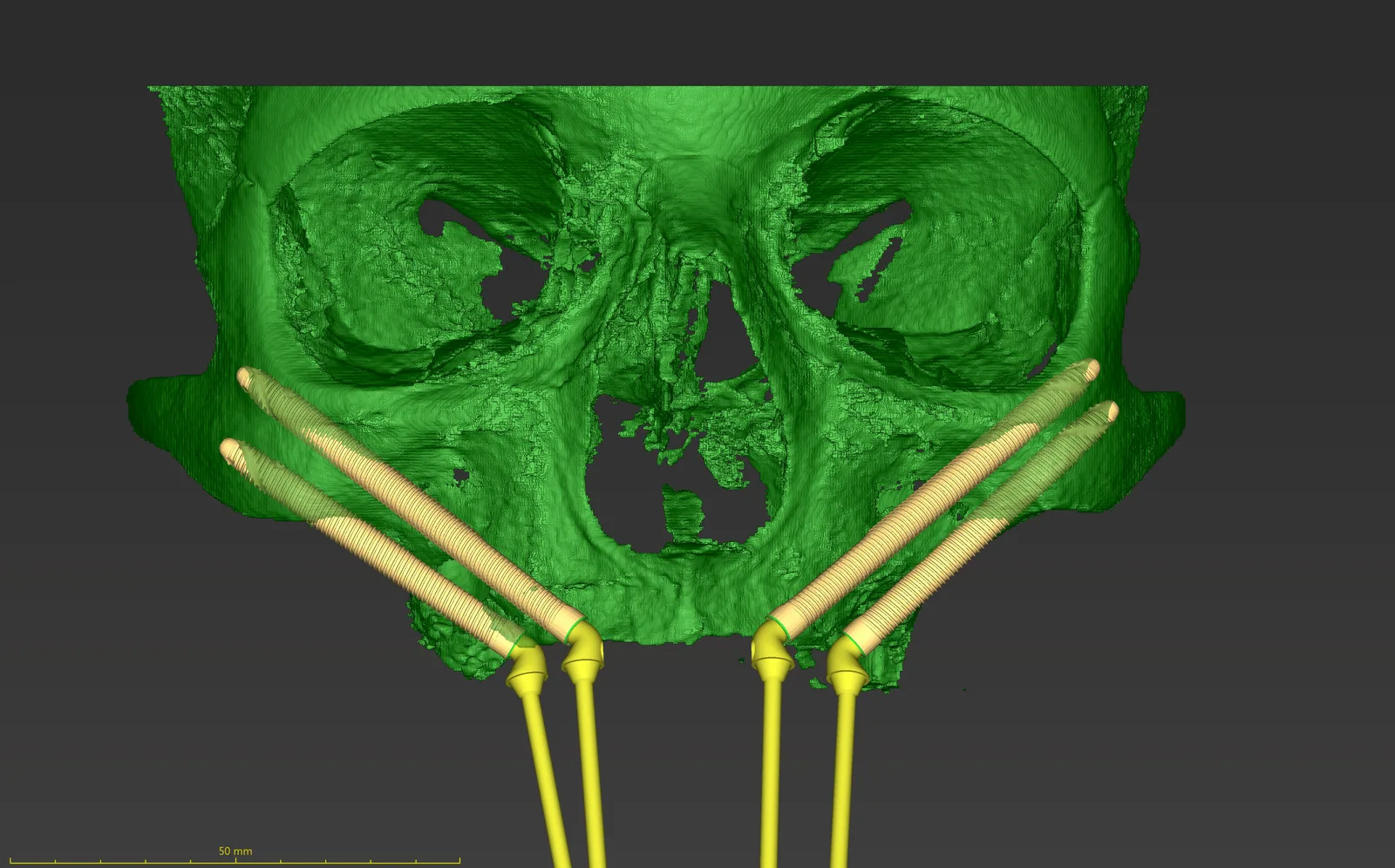
Zygomatic implants take a different route. They run from the upper jaw to the cheekbone (the zygoma), bone that does not shrink the way the tooth-bearing ridge does after teeth are lost, and they are often combined with conventional implants in the front or used as a set of four (quad zygoma). They are frequently indicated as an alternative to major bone graft reconstructions. When the implants are firm enough at surgery, fixed provisional teeth can be attached within days; in the main randomized trial, the threshold was an insertion torque above 40 Ncm. If they are not that firm, the teeth wait.
What the strongest evidence says
The most rigorous summary is the 2026 Cochrane review on zygomatic implants for the severely atrophic upper jaw. For the comparison with grafting it found a single randomized trial, followed for three years, so every conclusion below rests on that one study. The review concludes that zygomatic implants probably lead to fewer implant failures than conventional implants placed in grafted bone, but probably cause more complications (moderate-certainty evidence). Their effect on patient satisfaction is uncertain: they may make little or no difference.
The trial itself enrolled 71 patients with severely atrophic upper jaws; 35 received zygomatic implants. At one year, one prosthesis had failed or could not be delivered in the zygomatic group, versus six in the grafting group. On the other side of the ledger, 28 patients in the zygomatic group had complications, versus 14 in the grafting group. In the trial’s 4-month report, those complications resolved on their own or could be handled.
The 2023 consensus of the International Team for Implantology (ITI) adds that zygomatic implant survival appears comparable to that of conventional implants used in the atrophic upper jaw, including implants placed in grafted sinuses. It also calls for more randomized trials comparing zygomatic implants, short implants, staged grafts and tilted implants. In plain terms: the comparison is promising, but it is not settled.
Time to fixed teeth: 1.34 days versus 444.32 days
This is where the two paths differ most. In the trial, the average time to a functional fixed prosthesis was 1.34 days with zygomatic implants and 444.32 days with bone grafting and conventional implants. The difference is the waiting built into grafting: the graft has to consolidate before the implants go in, and the implants have to integrate before they carry teeth.
With zygomatic implants, the first teeth are provisional. In that trial they were replaced by the definitive bridge 4 months after the first loading, which was that study’s protocol rather than a universal rule. Counting visits up to one year after the teeth were placed, the zygomatic group averaged 15.12 dental visits and the grafting group 19.72, a difference that was not statistically significant.
If you are traveling to Costa Rica, the timeline matters even more. A staged graft plan means separate stays for the graft, the implants and the teeth, or arranging part of the care at home. A zygomatic plan concentrates the surgery and the provisional teeth in one stay when the implants are stable enough, with a return trip for the definitive bridge. We confirm the actual sequence after reviewing your CT scan.
Number of surgeries and recovery
A severely resorbed jaw restored with grafting typically goes through at least two surgical stages, the graft and later the implants, plus a second surgical site if your own bone is harvested. With zygomatic implants, the implants and the fixed provisional teeth are usually placed in one surgery; the later steps are prosthetic rather than surgical, unless a complication needs attention.
Recovery from zygomatic surgery is real. In the randomized trial, patients reported on average 7.17 days of total and 12.17 days of partial impaired activity after treatment. Swelling and bruising of the cheek and lip are common in the first days. On the grafting side, the recovery from each stage has to be added up.
Complications: different risks on each path
Neither path is risk-free, and the risks are not the same kind. With zygomatic implants:
- Sinusitis is the most commonly reported biological complication. Figures vary widely by study and technique: 2.4% in a large review and 14.2% at 5 years in a long-term review, with individual studies ranging from 2.8% to 36.4%. It can appear years after surgery. It has been treated successfully with antibiotics and/or sinus drainage surgery; when that fails, the implant may be lost.
- Numbness of the cheek or upper lip: figures range from 0.55% to 10.78% depending on the technique, and fifteen publications describe it as transient.
- An opening between the mouth and the sinus (oroantral fistula) is uncommon: 0.4% in a large review and up to 4.58% with the original technique.
- Rare but serious events, such as accidental entry into the eye socket, have been reported (four cases in three studies, one with damage to an eye muscle). The ITI describes zygomatic implants as a complex treatment whose success depends heavily on the surgeon’s skill and experience.
An umbrella review warns that complication rates for zygomatic implants may be underestimated because the studies differ so much from one another. With sinus grafting:
- A sinus lift is a reliable procedure: in studies of 5 years or more with the lateral-window technique, implant loss was 0.43% per year.
- The complications that most often need treatment are a tear in the sinus membrane, the wound opening, graft exposure or failure, and sinusitis. Membrane perforation occurs in about one in five sinus lift procedures.
- One meta-analysis that compared both procedures found sinusitis in 1.11% of patients after a sinus lift and in 3.76% after zygomatic implants, with differences by technique.
If you already have implants or a graft and notice facial swelling with fever, worsening sinus pain or discharge, or any change in your vision, contact your surgeon’s office promptly or go to an emergency service.
How do the implants hold up over time?
In studies with at least 5 years of follow-up, average survival was 96.5% for zygomatic implants and 95.8% for conventional implants, with no statistically significant difference. The annual risk of losing a zygomatic implant was estimated at 0.7%, higher in the first year (2%) than afterwards (0.5% per year). Zygomatic implants and their bridges may need more professional maintenance and have limits on chewing loads, which is worth discussing before you choose.
Who fits each path
Following the ITI consensus, zygomatic implants tend to fit when:
- Upper-jaw bone loss is too advanced for conventional implants without grafting.
- Previous grafts or implants have failed.
- You want to avoid staged bone grafting.
- Conditions such as benign cysts or trauma complicate grafting.
- Part of the upper jaw is missing after tumor surgery, trauma or a birth defect.
A graft, or another less invasive option, tends to fit when:
- Some usable bone remains: in borderline cases, short implants, tilted implants, bone regeneration or custom subperiosteal implants should also be considered.
- Bone is missing mainly at the back of the jaw, where a sinus lift with conventional implants has long-term data.
- You prefer the path that had fewer complications in the trial and can accept a much longer timeline.
Smoking raises the risk on both paths: across 107 studies, 6.35% of implants failed in smokers versus 3.18% in non-smokers. Choosing not to operate, or improving a conventional denture, is also a valid option.
How Dr. Torres decides with you
The ITI recommends analyzing every case individually and discussing the risks, the benefits, the final result, the total treatment time, the long-term outcomes and your preferences. That is how our practice approaches it. Dr. Ronald Torres is an oral and maxillofacial surgeon with his specialty from the National Autonomous University of Mexico (UNAM, 2013), certified by the Mexican Board of Oral and Maxillofacial Surgery, a professor at the University of Costa Rica School of Dentistry since 2006 and a member of the IAOMS. His Hospital CIMA profile lists sinus lift alongside immediate implant-supported bridges: grafting is part of his practice, not only zygomatic implants.
He starts with a CT scan of your midface, which the ITI recommends before zygomatic surgery: how much bone is left, where it is missing (the back of the jaw, the front or both) and how healthy your sinuses are, to rule out existing sinus disease. Then he walks you through each realistic option with its timeline and its risks. Patients often mention his explanations: 32 of his 104 reviews on HuliHealth, which average 5.0, talk about how he explains things. One patient wrote on March 26, 2023: «El doctor se tomó el tiempo suficiente para explicarme a fondo mi caso, de modo que yo entendiera plenamente lo que me estaba sucediendo» (“The doctor took enough time to explain my case to me thoroughly, so that I fully understood what was happening to me”). These reviews cover his oral and maxillofacial surgery practice in general, not implants in particular.
If you want a first opinion before you travel, send us your CT scan. Our candidate self-check explains what we look for, and our cost page explains what shapes the price; the exact quote comes after Dr. Torres evaluates your CT.
FAQ
Can I get zygomatic implants after a failed bone graft?
Often, yes. The ITI consensus lists failed previous grafts or implants among the main indications for zygomatic implants. Whether they fit your case depends on the bone left in your cheekbone and the health of your sinuses, which a CT scan of the midface shows.
How long after a bone graft can I get implants?
It depends on the type of graft and where it was placed. In some sinus lifts the implants go in during the same surgery, and long-term studies found no significant difference in implant loss compared with placing them later. Larger, staged grafts have to consolidate first. In the randomized trial, the whole grafting path took an average of 444.32 days to functional fixed teeth. Your surgeon sets the timing from your follow-up imaging.
Are zygomatic implants safer than a bone graft?
Neither is risk-free. The 2026 Cochrane review, based on one randomized trial for this comparison, concludes that zygomatic implants probably have fewer implant failures but probably more complications than implants in grafted bone. The risks also differ in kind: sinusitis and cheek numbness with zygomatic implants; membrane tears and wound or graft problems with a sinus graft.
Sinus lift or zygomatic implants: which do I need?
If bone is missing mainly at the back of the jaw and enough remains to work with, a sinus lift or short implants may be the simpler route; with the lateral-window technique, implant loss after a sinus lift was 0.43% per year in long-term studies. When the jaw is severely resorbed or earlier grafts failed, zygomatic implants become a reasonable option. Your CT scan decides.
Will zygomatic implants mean fewer trips to Costa Rica?
Usually the surgery and the fixed provisional teeth happen in one stay when the implants are firm enough, with a later return for the definitive bridge (4 months after loading in the trial’s protocol). A staged graft plan adds waiting time between surgeries. We map out your trips after reviewing your CT scan.
Does a bone graft cost less than zygomatic implants?
Not necessarily, and we do not quote surgery prices without a CT scan. The total depends on the number and type of implants, whether grafting or extra stages are needed, the provisional and definitive teeth and, if you travel, the number of trips. The exact quote comes after Dr. Torres evaluates your CT.
Sources
- 1.Visconti RF et al. — Interventions for replacing missing teeth: zygomatic implants for the rehabilitation of the severely atrophic edentulous maxilla. Cochrane Database Syst Rev, 2026.
- 2.Davó R et al. — Immediately loaded zygomatic implants vs conventional dental implants in augmented atrophic maxillae: 1-year post-loading results from a multicentre randomised controlled trial. Eur J Oral Implantol, 2018.
- 3.Esposito M et al. — Immediately loaded zygomatic implants vs conventional dental implants in augmented atrophic maxillae: 4 months post-loading results from a multicentre randomised controlled trial. Eur J Oral Implantol, 2018.
- 4.Al-Nawas B et al. — ITI consensus report on zygomatic implants: indications, evaluation of surgical techniques and long-term treatment outcomes. Int J Implant Dent, 2023.
- 5.Moraschini V et al. — Survival and complications of zygomatic implants compared to conventional implants reported in longitudinal studies with a follow-up period of at least 5 years: a systematic review and meta-analysis. Clin Implant Dent Relat Res, 2023.
- 6.Brennand Roper M et al. — Long-term treatment outcomes with zygomatic implants: a systematic review and meta-analysis. Int J Implant Dent, 2023.
- 7.Chrcanovic BR et al. — Survival and complications of zygomatic implants: an updated systematic review. J Oral Maxillofac Surg, 2016.
- 8.Kämmerer PW et al. — Evaluation of surgical techniques in survival rate and complications of zygomatic implants for the rehabilitation of the atrophic edentulous maxilla: a systematic review. Int J Implant Dent, 2023.
- 9.D’Ambrosio F et al. — Clinical risk and medico-legal implications in zygomatic implant rehabilitation: an umbrella review of systematic reviews. Diagnostics (Basel), 2026.
- 10.Rocha RS et al. — Comparison of sinusitis rate after sinus lift procedure and zygomatic implant surgery: a meta-analysis. Oral Maxillofac Surg, 2024.
- 11.Raghoebar GM et al. — Long-term effectiveness of maxillary sinus floor augmentation: a systematic review and meta-analysis. J Clin Periodontol, 2019.
- 12.Hsu YT et al. — Complications of sinus floor elevation procedure and management strategies: a systematic review. Clin Implant Dent Relat Res, 2022.
- 13.Liu Y et al. — Incidence and associated factors of Schneiderian membrane perforation in maxillary sinus floor elevation: a meta-analysis. Int Dent J, 2026.
- 14.Al-Nawas B, Schiegnitz E — Augmentation procedures using bone substitute materials or autogenous bone - a systematic review and meta-analysis. Eur J Oral Implantol, 2014.
- 15.Acerra A et al. — Zygomatic implants for rehabilitation of the atrophic maxilla: clinical indications, outcomes, complications, and evidence gaps — a comprehensive review. Medicina (Kaunas), 2026.
- 16.Chrcanovic BR et al. — Smoking and dental implants: a systematic review and meta-analysis. J Dent, 2015.
- Zygomatic implants
- Bone grafting
- Sinus lift
- Atrophic maxilla
- Clinical evidence