
Anchors in: The bone height you have, without reaching the sinus or the nerve
Short Implants
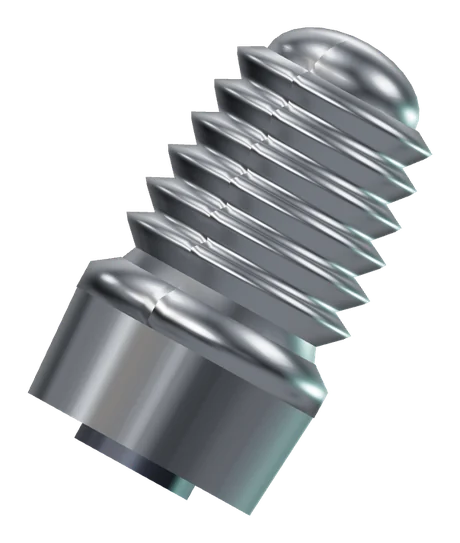
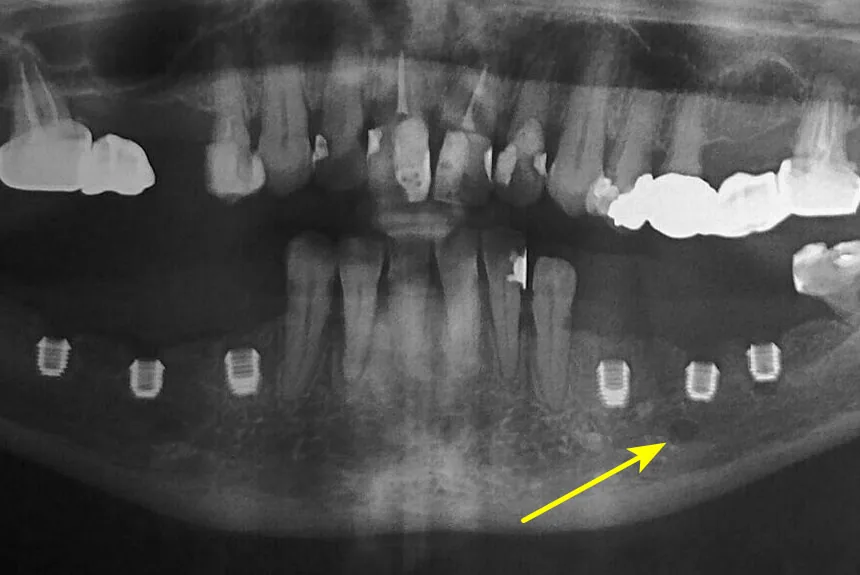
Short implants are an excellent and increasingly popular alternative for managing cases of moderate bone atrophy, primarily in terms of height.
Unlike the techniques we mentioned before (zygomatic, transnasal, pterygoid, subperiosteal), which resolve severe or extreme atrophy, short implants are a less invasive solution for when bone height is limited but still sufficient to anchor an implant of shorter length. Generally, an implant measuring 8 mm or less in length is considered “short.”
Short Implants
When they are indicated
- 01
Moderate vertical bone atrophy
This is the primary indication. They are used when there is not enough bone height to place a standard-length implant (generally 10 mm or more).
- 02
Avoiding key anatomical structures
In the upper jaw (posterior area), to avoid perforating the floor of the maxillary sinus — it is the direct alternative to “sinus lift” surgery. In the mandible (posterior area), to avoid damaging the inferior alveolar nerve, which could cause paresthesia (permanent or temporary numbness of the lip and chin).
- 03
Patients who refuse grafts
For patients who do not wish to undergo bone grafting surgeries (such as a sinus lift), whether due to the cost, the waiting time, or the post-operative recovery.
- 04
Patients with surgical risks
In elderly patients or those with medical conditions (such as uncontrolled diabetes, heavy smoking, etc.) where a longer, more complex grafting surgery presents higher risks of complications.
Who it is for
- You have lost some bone height in the back of the jaw, but your CT shows enough left for an implant of 8 mm or less.
- You were told you need a sinus lift for upper back teeth and would rather avoid the graft, the extra surgery or the wait.
- You need an implant in the back of the lower jaw, close above the nerve that gives feeling to the lip and chin.
- Your age or health makes a longer grafting surgery riskier.
- You can keep up regular check-ups and cleanings.
When it is not the right option
- The bone left is extremely short: for 4 and 5 mm implants the evidence is still inconclusive, so we weigh other techniques.
- The whole upper jaw has severe bone loss: that calls for zygomatic, pterygoid or transnasal anchorage.
- There is active gum disease, infection or untreated sinus disease: it is treated first.
- Blood sugar is not yet controlled: it is adjusted first with your physician; a 2024 review advises measuring HbA1c when planning implants.
Measuring your bone on a 3D CT scan
The American Academy of Oral and Maxillofacial Radiology recommends cross-sectional imaging for every implant site, with cone beam CT as the method of choice. On your scan, Dr. Torres measures the height and width of the bone, traces the sinus floor or the nerve canal, and chooses a length and position that stay clear of them.
Studies define “short” differently (8 mm or less in some, 6 mm or less in others), so we always say which length a result refers to. When a surgical guide designed on the CT is used, a review of guide accuracy recommends planning a safety margin of at least 2 mm.
Short implant or sinus lift: what the studies show
The classic answer to low bone height in the upper back jaw is a sinus lift with graft; a short implant skips that step. In a 2026 meta-analysis of 8 randomized trials, implants of 8 mm or less and standard implants with a sinus lift showed no statistically significant difference in failures. A 2024 review found moderate to high certainty evidence of similar 5-year survival for 6 mm implants used instead of a sinus lift.
The picture is not one-sided. In another analysis, results at 5 years leaned toward longer grafted implants without reaching statistical significance, while short implants lost less bone around them. Trials of 5 years or more carry a high risk of bias, so firm long-term conclusions are not yet possible, and the sinus lift is reliable in its own right. That is why we explain both options before you decide.
The day of surgery and the first days
Without a graft, surgery is generally shorter: the implant goes into the bone you have, under local anesthesia, and sedation options are discussed at your evaluation. Pain control may matter most in the first 72 hours, and a 2026 review found less pain at 3 and 7 days with graftless approaches than with a grafted sinus lift.
If swelling keeps growing, or you have fever, bleeding that does not stop or numbness that does not wear off, contact our office right away; in an emergency, go to the nearest emergency service.
Why a maxillofacial surgeon makes the call
Choosing a short implant is a decision about anatomy: how close the sinus or nerve is, and what comes next if the bone is shorter than expected. Our practice offers the whole range, from guided conventional implants to zygomatic and custom subperiosteal implants, so the recommendation is not tied to one technique.
Every surgery is led by Dr. Ronald Torres Labardini, oral and maxillofacial surgeon (UNAM specialty, 2013), certified by the Mexican Board of Oral and Maxillofacial Surgery, IAOMS member and professor at the University of Costa Rica School of Dentistry since 2006. He sees patients in English and Spanish in Tower 1 of Hospital CIMA, Escazú; his surgical practice holds 5.0 across 106 patient reviews on HuliHealth.
From consultation to final teeth
- Write to usSend a recent CT scan if you have one; it makes the first evaluation more useful.
- Consultation and CTDr. Torres examines you, reviews your health and medications, and measures your bone in 3D.
- Your planShort implant, sinus lift or another technique, with the risks and benefits of each. The exact quote comes after evaluating the CT.
- Implant placementIn the bone you already have, without a sinus lift or graft.
- HealingThe bone bonds to the implant; the timing is set after evaluation. If the gap shows when you smile, we discuss temporary options.
- Final crown and check-upsThe crown or bridge is attached and regular maintenance begins.
Short Implants
Risks and how we manage them
Every surgery carries risks. These are the real ones for this technique, and what we do about each.
- The implant does not integrate, or is lost later
- In 8 randomized trials, implants of 8 mm or less showed no statistically significant difference in failures from standard implants with a sinus lift. In one review, smokers had double the risk of early implant failure. Prevention: case selection on the CT, no smoking, controlled blood sugar. Management: the implant is removed, the site heals and a new plan is made.
- Numbness of the lip or chin (lower jaw)
- Prevention: the nerve canal is traced on the CT and the implant length leaves a safety margin. Management: if numbness remains once the anesthesia wears off, contact us right away for prompt assessment.
- Reaching the sinus (upper jaw)
- Prevention: the length is chosen to stay below the sinus floor, and any sinus disease is treated first. Management: if you notice one-sided congestion, discharge or cheek pain after surgery, contact us for an evaluation.
- Peri-implantitis (inflammation around the implant)
- Reviews of implants in general found it in 21% to 25.0% of patients. Prevention: treating gum disease first, not smoking and controlled diabetes (gum disease, diabetes and smoking are linked to it), plus regular check-ups, which are linked to a lower risk. Management: early detection, deep cleaning and, if it progresses, surgical treatment.
- A tall crown on a short implant
- Prevention: the crown and the bite are designed to spread chewing forces. Management: screws and crowns are checked at maintenance visits and adjusted or repaired.
FAQ
Need more info?
Contact us to get answers or schedule your dental implant consultation.
What length counts as a short implant?
Generally 8 mm or less; standard implants usually measure 10 mm or more. Some studies set the line at 6 mm. For 4 and 5 mm implants used instead of a sinus lift, the evidence is still inconclusive, so we tell you which length your plan uses and why.
Do short implants last as long as longer ones?
The randomized evidence reaches 5 years, with similar survival for 6 mm implants placed instead of a sinus lift. Beyond 5 years the trials have a high risk of bias, so firm conclusions are not yet possible. Regular maintenance lowers the risk for any implant.
Is a short implant better than a sinus lift?
Neither is better for everyone. The Cochrane review found that, with 4 to 9 mm of bone, it is unclear whether a sinus lift or short implants (5 to 8.5 mm) work better at one year, but sinus lift sites had more complications. With the lateral-window technique, studies of 5 years or more found implant loss of 0.43% per year. We decide together after the CT.
Can short implants be used in the lower jaw?
Yes, to stay above the inferior alveolar nerve. A 2024 review found, with moderate to high certainty, similar 5-year survival for implants of 6 mm or less and of 10 mm or more placed in bone that had not been grafted, in either jaw.
When can I fly home after the surgery?
A 2023 review of expert recommendations suggests flying, as a rule, one week after most dental procedures, and no sooner than 72 hours after uncomplicated implant placement. The evidence is scarce and comes mostly from military aircrew, so Dr. Torres confirms your date; how long you stay in Costa Rica is defined in your plan.
Do I need a bone graft first?
Our approach is graftless: we anchor specialized implants in dense bone that is still there, so you avoid the cost and the months of waiting that grafts require — and you can receive a fixed provisional prosthesis right away.
How is the surgery planned?
We merge your photographs, intraoral scan and 3D CT scan into a virtual model of your anatomy, perform the surgery virtually with millimeter-level accuracy, and fabricate custom surgical guides so each implant goes exactly where it was planned.
How much does it cost?
Every case is different, so the plan — and its cost — is defined after your evaluation and CT scan. Write to us and we will guide you through the first step.
Sources
- 1.Wang C et al. — Short implants (≤ 8 mm) versus standard implants with sinus floor elevation in the atrophic posterior maxilla: A systematic review and meta-analysis of randomized controlled trials. J Stomatol Oral Maxillofac Surg, 2026.
- 2.Ravidà A et al. — Short (≤6 mm) compared with ≥10-mm dental implants in different clinical scenarios: A systematic review of randomized clinical trials with meta-analysis, trial sequential analysis and quality of evidence grading. J Clin Periodontol, 2024.
- 3.Grunau O et al. — Lateral augmentation of the sinus floor followed by regular implants versus short implants in the vertically deficient posterior maxilla: a systematic review and timewise meta-analysis of randomized studies. Int J Oral Maxillofac Surg, 2023.
- 4.Alemán BO et al. — Long-Term Outcomes of Short versus Long Dental Implants with Sinus Lift in Atrophied Posterior Maxillae: A Systematic Review and Meta-Analysis. P R Health Sci J, 2025.
- 5.Esposito M et al. — Interventions for replacing missing teeth: augmentation procedures of the maxillary sinus. Cochrane Database Syst Rev, 2014.
- 6.Raghoebar GM et al. — Long-term effectiveness of maxillary sinus floor augmentation: A systematic review and meta-analysis. J Clin Periodontol, 2019.
- 7.Menini M et al. — Patient-Reported Outcome Measures (PROMs) in Sinus Elevation Procedures: A Systematic Review and Meta-analysis. Int J Oral Maxillofac Implants, 2026.
- 8.Tyndall DA et al. — Position statement of the American Academy of Oral and Maxillofacial Radiology on selection criteria for the use of radiology in dental implantology with emphasis on cone beam computed tomography. Oral Surg Oral Med Oral Pathol Oral Radiol, 2012.
- 9.Tahmaseb A et al. — The accuracy of static computer-aided implant surgery: A systematic review and meta-analysis. Clin Oral Implants Res, 2018.
- 10.Khouly I et al. — Post-operative pain management in dental implant surgery: a systematic review and meta-analysis of randomized clinical trials. Clin Oral Investig, 2021.
- 11.Fan YY et al. — Smoking in relation to early dental implant failure: A systematic review and meta-analysis. J Dent, 2024.
- 12.Bencze B et al. — Prediabetes and poorly controlled type-2 diabetes as risk indicators for peri-implant diseases: A systematic review and meta-analysis. J Dent, 2024.
- 13.Galarraga-Vinueza ME et al. — Prevalence, incidence, systemic, behavioral, and patient-related risk factors and indicators for peri-implant diseases: An AO/AAP systematic review and meta-analysis. J Periodontol, 2025.
- 14.Reis INRD et al. — The prevalence of peri-implant mucositis and peri-implantitis based on the world workshop criteria: A systematic review and meta-analysis. J Dent, 2025.
- 15.Carra MC et al. — Primordial and primary prevention of peri-implant diseases: A systematic review and meta-analysis. J Clin Periodontol, 2023.
- 16.Felkai PP et al. — Dental tourism and the risk of barotrauma and barodontalgia. Br Dent J, 2023.
Schedule your consultation
Take the first step to your perfect smile today
We are here to answer your questions and guide you through the process.